Build a Real-Time ML Feature Store
data-engineering performance caching
System Design Deep Dive
Real-Time ML Feature Store
Serve features in under 5 milliseconds while training and serving read the exact same numbers.
Picture an air traffic control room next to its incident investigation archive. The controller’s radar screen has to show a plane’s current position within a second or two, refreshed constantly, discarded the moment it is stale, because the only thing that matters is right now. Months later, when investigators reconstruct a near-miss, they do not want that live feed. They want an immutable record of exactly what the controller’s screen showed at 14:32:07, not data that trickled in a minute afterward and quietly rewrote history. Both views describe the same airspace, but they are built for opposite jobs, one optimized for speed and recency, the other for completeness and precise timing, and if the two ever disagree about where a plane was, someone has a very bad day.
A real-time ML feature store is that control room and that archive, serving the same numbers for two audiences with irreconcilable requirements. An online payments platform running fraud and recommendation models needs a feature vector, a user’s transaction velocity, a merchant’s chargeback rate, a device’s recent login pattern, delivered to the scoring service in under 5 milliseconds at checkout time, because nobody waits three seconds for a card to authorize. The team training tomorrow’s fraud model needs the opposite: a precisely time-stamped history of every feature value that ever existed, so a training row labeled “fraudulent” from six weeks ago is joined only to the feature values that were actually known at that exact moment, not to information that arrived later and would let the model cheat by seeing the future.
The naive approach is to let each team solve this independently. A data scientist computes “average transaction amount over the last 7 days” in a notebook against the warehouse, ships a model, and an engineer reimplements the same logic in the online serving path using whatever the production database happens to expose. The two implementations round differently, bucket time zones differently, or handle nulls differently, and the model that scored beautifully offline degrades in production for reasons nobody can quite pin down, a phenomenon with a name: training-serving skew. Querying the transactional database directly at inference time fails for a more basic reason, it was built for row lookups and writes, not for assembling a 40-feature vector under a 5-millisecond budget while a payments system is also trying to write to the same tables. And naively joining historical events to training labels by “just take the latest value” silently leaks the future into the past, producing a model that looks accurate in every offline metric and then fails the moment it meets data it could not have seen in advance.
The forces in tension are latency against completeness, and consistency against duplicated logic. We need to solve for a serving path that answers a feature lookup in single-digit milliseconds without ever touching a raw event log, a point-in-time correct join capability that can reconstruct exactly what was known at any past moment without leaking the future, a single shared definition of every feature so the number computed for training and the number computed for serving are the same code path rather than two, and a materialization pipeline that keeps the fast path fresh within a bounded, monitored staleness budget.
Requirements and Constraints
Functional Requirements
- Register every feature in a central feature registry with its name, owning team, entity type, data type, and a versioned reference to the exact transformation logic that produces it
- Serve a pre-computed feature vector for one or more entity IDs from a low-latency online store, given a model’s declared list of required features
- Materialize features from streaming and batch sources into both the online store and the offline store using the same transformation logic, on a schedule or trigger defined per feature group
- Support point-in-time correct joins: given a set of labeled rows with entity IDs and timestamps, return the feature values that were actually known as of each timestamp, with no leakage from future or late-arriving data
- Pin a specific feature version to a specific trained model so that model can be scored consistently months or years later, even after the feature’s definition evolves
- Detect and alert on training-serving skew by comparing the statistical distribution of features as computed offline against the same features as observed in the online store
- Track feature freshness against a per-feature-group service level objective and alert when materialization falls behind
Non-Functional Requirements
- Scale: 50 million tracked entities (users, merchants, devices), 5,000 registered features across 200 feature groups, roughly 10,000 feature-update events per second sustained via streaming ingestion
- Online read latency: p99 under 5ms and p50 under 1ms for a feature vector lookup, at a sustained peak of 300,000 requests per second, each request reading around 20 features
- Freshness: a default staleness SLO of 5 minutes for batch-derived feature groups, configurable down to 30 seconds for streaming feature groups used in fraud scoring
- Offline join throughput: construct a training dataset joining 500 million labeled rows against 40 features per row within a 4-hour nightly batch window
- Availability: 99.99% for the online serving path; the offline path can tolerate a few hours of degraded availability without affecting live inference
- Consistency: feature values computed for training and for serving must be bit-for-bit identical for the same entity, timestamp, and feature version, measured by a continuous skew-detection job
- Retention: the offline feature log is retained for at least 2 years to support retraining and point-in-time audits of past model decisions
Constraints and Assumptions
- We are not building a general-purpose stream processing engine; the pipeline orchestrator runs on top of an existing engine such as Flink or Spark Structured Streaming
- We are not building the model training loop, the model registry, or the experiment tracking system; this design covers only the feature layer those systems consume
- We assume every feature’s transformation logic is expressed once, in a shared definition that both the streaming and batch execution paths can run unmodified, rather than being reimplemented per path
- Feature discovery tooling (a searchable UI/catalog on top of the registry) is a thin consumer of the registry API and is out of scope for this design
- We assume upstream event sources (transaction streams, clickstreams, warehouse tables) already exist and are reliable; the interfaces that produce those raw events are out of scope
High-Level Architecture
The system has six major components: the Feature Registry, the Feature Pipeline Orchestrator, the Online Feature Store, the Offline Feature Store, the Point-in-Time Join Engine, and the client services that consume them, an Online Inference Service and offline Training Jobs.
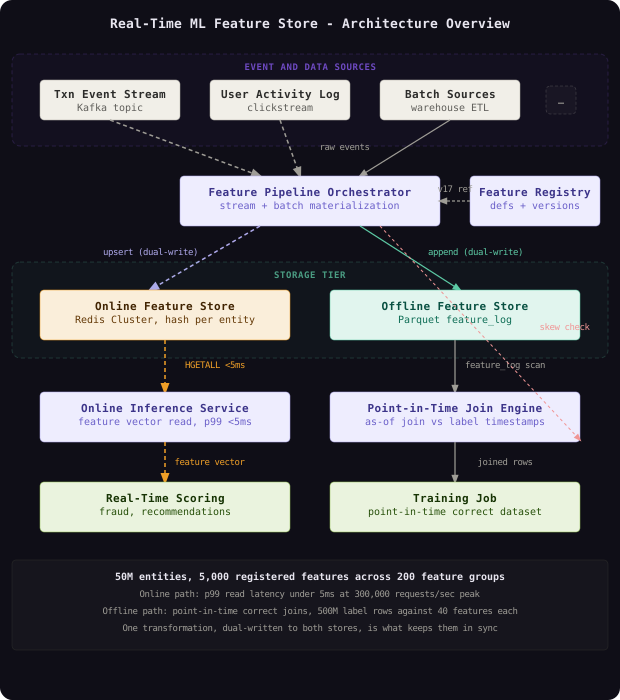
A raw event, a checkout transaction, a page view, a device fingerprint, arrives from an event source and reaches the Feature Pipeline Orchestrator, which executes the transformation logic defined in the Feature Registry to compute one or more feature values. That single computation is dual-written in the same pipeline run to the Online Feature Store, a low-latency key-value layer keyed by entity ID, and to the Offline Feature Store, an append-only, time-partitioned log that never overwrites a prior value. The Online Inference Service reads a feature vector for an entity directly from the Online Feature Store in single-digit milliseconds at request time. Separately, when a training job needs a labeled dataset, it hands a set of entity IDs and label timestamps to the Point-in-Time Join Engine, which reconstructs, for every label, exactly the feature values that existed at that moment by querying the Offline Feature Store.
The Feature Registry sits beside all of this as the source of truth, not in the data path itself. Every feature the pipeline materializes, every read the inference service issues, and every join the training path performs resolves its feature definition and version through the registry first. That single reference point is what keeps a feature named txn_amount_sum_1h meaning the same computed value everywhere it appears.
The single most important architectural decision is that one pipeline run writes to both stores from one computed value. Nothing downstream ever recomputes a feature independently for the offline path. That single-writer, dual-sink pattern is what makes training-serving skew a monitored anomaly instead of a structural inevitability.
Component Deep Dives
The Feature Registry
This component’s job is to be the single, versioned source of truth for what a feature means, who owns it, and which exact transformation logic produced it.
A reasonable-sounding shortcut is to assume a feature name is enough, if two pipelines both compute something called avg_txn_amount_7d, they must be computing the same thing. In practice they usually are not. One team’s notebook buckets by UTC day, another team’s streaming job buckets by a sliding 7-day window with a different rounding rule, and both call the result the same name. The registry fixes this by making every feature reference a specific feature_version, not just a name, and by storing a content hash of the transformation logic itself, so a silent code change is detectable even if nobody updates the version number.
-- Feature registry: definitions, ownership, and versioned transformation logic
CREATE TABLE feature_groups (
    feature_group_id      BIGSERIAL PRIMARY KEY,
    name                   TEXT NOT NULL UNIQUE,
    entity_type            TEXT NOT NULL,
    owner_team             TEXT NOT NULL,
    source_type            TEXT NOT NULL CHECK (source_type IN ('stream', 'batch', 'on_demand')),
    freshness_slo_seconds   INTEGER NOT NULL DEFAULT 300,
    created_at              TIMESTAMPTZ NOT NULL DEFAULT NOW()
);

CREATE TABLE features (
    feature_id           BIGSERIAL PRIMARY KEY,
    feature_group_id     BIGINT NOT NULL REFERENCES feature_groups(feature_group_id),
    name                  TEXT NOT NULL,
    dtype                 TEXT NOT NULL CHECK (dtype IN ('int64', 'float64', 'bool', 'string', 'embedding')),
    description           TEXT NOT NULL DEFAULT '',
    UNIQUE (feature_group_id, name)
);

CREATE TABLE feature_versions (
    version_id            BIGSERIAL PRIMARY KEY,
    feature_id            BIGINT NOT NULL REFERENCES features(feature_id),
    version_number         INTEGER NOT NULL,
    transformation_ref      TEXT NOT NULL,
    transformation_hash     CHAR(64) NOT NULL,
    is_active               BOOLEAN NOT NULL DEFAULT TRUE,
    published_at            TIMESTAMPTZ NOT NULL DEFAULT NOW(),
    UNIQUE (feature_id, version_number)
);
CREATE INDEX ON feature_versions (feature_id) WHERE is_active;

-- Pins a model to the exact feature version it was trained against
CREATE TABLE model_feature_bindings (
    binding_id            BIGSERIAL PRIMARY KEY,
    model_name             TEXT NOT NULL,
    model_version           TEXT NOT NULL,
    feature_id              BIGINT NOT NULL REFERENCES features(feature_id),
    version_id               BIGINT NOT NULL REFERENCES feature_versions(version_id),
    bound_at                 TIMESTAMPTZ NOT NULL DEFAULT NOW(),
    UNIQUE (model_name, model_version, feature_id)
);
Without versioning, retraining a model six months later against the “current” definition of a feature silently changes what that feature means, and nobody can explain why a model that used to work now behaves differently. model_feature_bindings is what lets an old model keep scoring correctly even as the feature catalog evolves underneath it, because the binding pins a specific version_id, not a name that can quietly drift.
Publishing a breaking change to a feature, a dtype change or a redefinition of the aggregation window, without bumping version_number is the single most common way registries get corrupted in practice. Enforce the transformation_hash check at publish time and reject any update to an existing version whose hash does not match what was originally recorded.
Uber’s Michelangelo platform and the open-source Feast project both center their design on exactly this registry-first model: a feature is not a column in a table, it is a versioned definition that any number of pipelines and models can reference without re-deriving its meaning.
The Feature Pipeline Orchestrator
This component’s job is to turn raw events into computed feature values and write that single computed value into both the online and offline stores, on a schedule that meets each feature group’s freshness SLO.
The tempting shortcut is to run two separate pipelines, a fast streaming job that updates the online store and a nightly batch job that backfills the offline store, each with its own implementation of the transformation logic. That is precisely how training-serving skew gets built into a system from day one, because two independently maintained code paths will drift, in float rounding, in null handling, in how a time window’s boundary is treated, long before anyone notices in a dashboard. The orchestrator instead runs one transformation per event, referenced by transformation_ref from the registry, and dual-writes its single output.
# Feature pipeline definition for a fraud-scoring feature group
feature_group: user_txn_velocity
entity_type: user
owner_team: fraud-platform
source:
  type: stream
  topic: txn-events-v3
  format: avro
freshness_slo_seconds: 30
materialization:
  online:
    sink: redis-cluster-fs-online
    key_prefix: "fs:user:"
    write_mode: upsert
  offline:
    sink: warehouse.feature_log
    partition_by: event_date
    write_mode: append
transformations:
  - name: txn_count_1h
    window: 1h
    agg: count
    dtype: int64
  - name: txn_amount_sum_1h
    window: 1h
    agg: sum
    source_field: amount
    dtype: float64
  - name: device_change_flag
    window: 24h
    agg: distinct_count_gt_1
    source_field: device_id
    dtype: bool
backfill:
  enabled: true
  lookback_days: 90
  engine: spark
monitoring:
  staleness_alert_threshold_seconds: 60
  skew_check:
    enabled: true
    method: psi
    schedule: "0 */6 * * *"
The same transformations block runs under the streaming engine for the online sink and under the batch engine for a backfill or the offline sink, because both engines execute the identical registered transformation rather than a hand-translated copy of it. A feature group with a 30-second freshness SLO, like user_txn_velocity, runs continuously off the stream; a feature group built from a slow-changing warehouse dimension can run on an hourly or daily batch schedule instead, and the orchestrator tracks each feature group’s actual staleness independently.
If a feature group’s freshness_slo_seconds is set once at creation and never revisited, it quietly becomes wrong as the feature’s usage changes, a feature originally built for a daily batch report and later adopted by a real-time fraud model needs a far tighter SLO than its creators assumed. Freshness requirements should be reviewed whenever a new model binds to an existing feature.
Feast’s architecture and Tecton’s managed feature platform both converge on this same pattern, a unified transformation definition executed by both a streaming and a batch materialization engine, specifically to eliminate the dual-implementation source of skew.
The Online Feature Store
This component’s job is to serve a complete feature vector for one or more entities in single-digit milliseconds, at hundreds of thousands of requests per second.
The natural first instinct is to read features directly from whatever database already holds the entity’s canonical record, a user’s row in the primary transactional database. That fails for two separate reasons: a relational lookup optimized for transactional writes rarely hits a 5-millisecond p99 once a payments system is also hammering the same tables, and a feature vector is shaped completely differently from a normalized row, it is a flat, denormalized bag of 20 to 40 named values that changes independently of the entity’s core record. The online store is purpose-built for exactly one access pattern: fetch everything known about one entity, fast.
# Writing a feature vector for one entity as a hash, one HSET per materialization write
HSET fs:user:usr_88213 txn_count_1h 4 txn_amount_sum_1h 812.40 device_change_flag 0 _version 17 _updated_at 1783785600

# Setting a TTL so an entity with no recent writes ages out of the hot tier automatically
EXPIRE fs:user:usr_88213 604800

# Reading the full feature vector for one entity at inference time
HGETALL fs:user:usr_88213

# Reading only the features one specific model needs, avoiding a full hash scan
HMGET fs:user:usr_88213 txn_count_1h txn_amount_sum_1h device_change_flag

# Batching reads for several entity types touched by a single scoring request
MULTI
HGETALL fs:user:usr_88213
HGETALL fs:merchant:mch_50142
HGETALL fs:device:dvc_9931a
EXEC
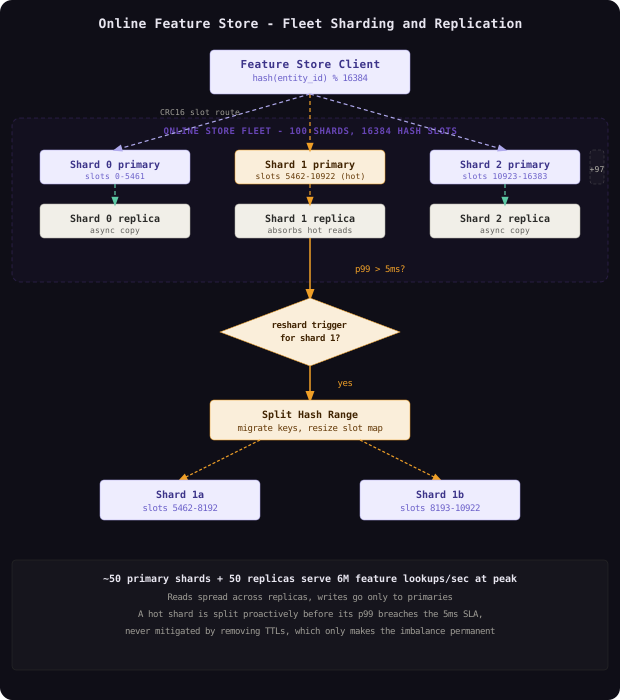
Each entity’s feature vector lives in one Redis hash, keyed by entity_type:entity_id, so a single HGETALL or HMGET retrieves the full vector without a cross-shard fan-out. The cluster is sharded by hashing the key across 16,384 hash slots, and read replicas absorb the read-heavy traffic pattern, since online inference reads outnumber materialization writes by roughly two orders of magnitude at this scale.
A single viral merchant or a bot-driven device ID can turn one hash slot into a hot shard, degrading p99 latency for every other entity that happens to share it. Mitigate with client-side caching for the hottest few thousand keys and by splitting a hot shard’s range proactively rather than waiting for the SLA to breach; never respond to a hot key by removing its TTL, which only makes the imbalance permanent.
DoorDash’s and Uber’s online feature serving layers are both built on sharded in-memory key-value stores for this exact reason, an in-memory hash lookup is one of the few storage primitives that reliably clears a single-digit-millisecond bar at hundreds of thousands of requests per second.
The Offline Feature Store
This component’s job is to hold a complete, immutable, time-stamped history of every feature value ever computed, so any past moment can be reconstructed exactly for training.
The instinctive design is to treat the offline store like the online store, one row per entity, updated in place as new values arrive. That destroys the one property the offline store exists to provide: if a value is overwritten, there is no way to answer “what did we know about this entity last Tuesday at 3pm,” because last Tuesday’s value is gone. The offline store has to be append-only, keyed by when the event happened, not just what the current value is.
-- Offline feature log: immutable, event-time partitioned, the source of truth
-- for point-in-time correct training set construction
CREATE TABLE feature_log (
    entity_type            TEXT NOT NULL,
    entity_id               TEXT NOT NULL,
    feature_group            TEXT NOT NULL,
    feature_name              TEXT NOT NULL,
    feature_version             INTEGER NOT NULL,
    value_double                  DOUBLE PRECISION,
    value_string                    TEXT,
    event_timestamp                   TIMESTAMPTZ NOT NULL,
    ingestion_timestamp                 TIMESTAMPTZ NOT NULL DEFAULT NOW(),
    event_date                            DATE NOT NULL
)
PARTITIONED BY (event_date)
STORED AS PARQUET;

CREATE INDEX ON feature_log (entity_type, entity_id, feature_name, event_timestamp);

-- One row per point-in-time join run, pinned to specific feature versions
-- so a training set can be reproduced exactly
CREATE TABLE training_dataset_snapshots (
    snapshot_id              BIGSERIAL PRIMARY KEY,
    dataset_name               TEXT NOT NULL,
    entity_type                  TEXT NOT NULL,
    label_source                   TEXT NOT NULL,
    feature_version_pins             JSONB NOT NULL,
    row_count                          BIGINT NOT NULL,
    created_at                           TIMESTAMPTZ NOT NULL DEFAULT NOW()
);
event_timestamp records when the underlying event actually happened; ingestion_timestamp records when this specific row became queryable. Keeping both is what lets the Point-in-Time Join Engine distinguish “this feature value existed at the label’s timestamp” from “this feature value is dated in the past but was only backfilled or corrected after the label’s timestamp,” a distinction the online store’s overwrite-in-place model has no way to express.
Treating feature_log as a table you can UPDATE to fix a bad value is the fastest way to quietly corrupt every training set built from it afterward. Corrections must be inserted as new rows with a later ingestion_timestamp, never as an in-place mutation of history.
Tecton markets this capability explicitly as “time travel,” and Feast’s offline store implements the same event-time-partitioned, append-only log on top of a data warehouse or Parquet files in object storage, precisely to support reconstructing historical state for training.
The Point-in-Time Join Engine
This component’s job is to attach, to every labeled training row, exactly the feature values that were knowable at that row’s timestamp, and nothing that arrived later.
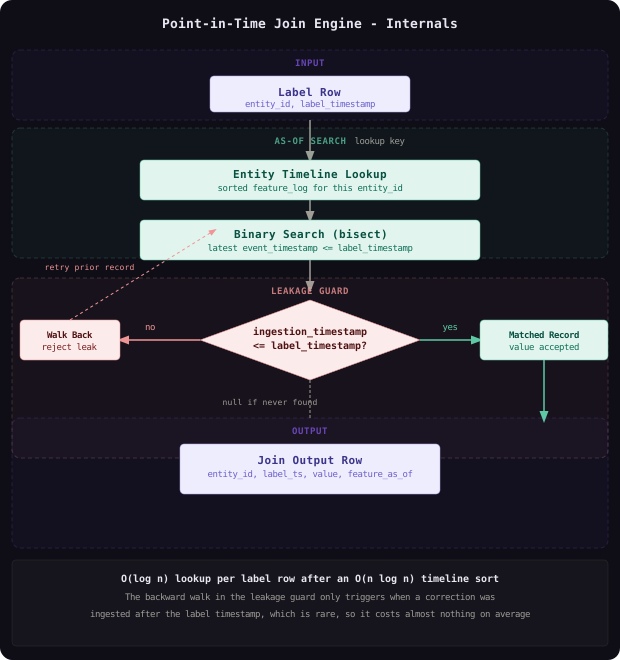
A smart engineer’s first instinct when joining labels to features is to filter feature_log by event_timestamp <= label_timestamp and call it done. That is not sufficient. A correction can carry an event_timestamp from last month while only being ingested this morning, after the label was generated, and a naive join happily attaches that corrected value to a training row that, at the time the label was created, could not possibly have seen it. This is the single most common source of subtle label leakage in feature stores, and it is invisible in every offline accuracy metric, because the leaked information genuinely does correlate with the outcome.
# Point-in-time correct join: attaches the feature values that were actually
# known as of each label's timestamp, using both event_timestamp and
# ingestion_timestamp to prevent leakage from late-arriving corrections
import bisect
from collections import defaultdict
from dataclasses import dataclass
from typing import Optional

@dataclass
class FeatureRecord:
    entity_id: str
    event_timestamp: int      # when the underlying event happened
    ingestion_timestamp: int  # when this value became queryable
    value: float

def build_entity_timelines(feature_log: list) -> dict:
    timelines = defaultdict(list)
    for rec in feature_log:
        timelines[rec.entity_id].append(rec)
    for entity_id in timelines:
        timelines[entity_id].sort(key=lambda r: r.event_timestamp)
    return timelines

def lookup_as_of(timeline: list, as_of_ts: int) -> Optional[FeatureRecord]:
    # Binary search to the latest record whose event_timestamp <= as_of_ts,
    # then walk backward until ingestion_timestamp <= as_of_ts is also true,
    # since a later event can still have an earlier ingestion time
    event_timestamps = [r.event_timestamp for r in timeline]
    idx = bisect.bisect_right(event_timestamps, as_of_ts) - 1
    while idx >= 0:
        candidate = timeline[idx]
        if candidate.ingestion_timestamp <= as_of_ts:
            return candidate
        idx -= 1
    return None

def point_in_time_join(entity_requests: list, feature_log: list) -> list:
    # entity_requests: [{"entity_id": ..., "label_timestamp": ...}, ...]
    timelines = build_entity_timelines(feature_log)
    joined = []
    for request in entity_requests:
        timeline = timelines.get(request["entity_id"], [])
        match = lookup_as_of(timeline, request["label_timestamp"])
        joined.append({
            "entity_id": request["entity_id"],
            "label_timestamp": request["label_timestamp"],
            "feature_value": match.value if match else None,
            "feature_as_of": match.event_timestamp if match else None,
        })
    return joined
At warehouse scale, the same logic runs as a SQL join rather than in-process Python, using a lateral subquery to fetch the latest qualifying row per label:
-- Point-in-time correct join using a LATERAL subquery: for every label row,
-- pull the latest feature value that was actually known as of that label's timestamp
SELECT
    l.entity_id,
    l.label_timestamp,
    l.label,
    f.value_double AS txn_amount_sum_1h,
    f.event_timestamp AS feature_as_of
FROM labels l
LEFT JOIN LATERAL (
    SELECT value_double, event_timestamp
    FROM feature_log
    WHERE feature_log.entity_id = l.entity_id
      AND feature_log.feature_name = 'txn_amount_sum_1h'
      AND feature_log.event_timestamp <= l.label_timestamp
      AND feature_log.ingestion_timestamp <= l.label_timestamp
    ORDER BY feature_log.event_timestamp DESC
    LIMIT 1
) f ON TRUE
ORDER BY l.entity_id, l.label_timestamp;
Building a per-entity sorted timeline turns what would be an O(n * m) comparison between every label and every feature record into an O(n log n) sort followed by an O(log n) binary search per lookup, with a small constant-factor backward walk to satisfy the ingestion-time guard, which in practice touches only a handful of records even for entities with frequent corrections.
The property that makes point-in-time joins correct is treating “known as of” as a function of two timestamps, not one. event_timestamp alone tells you what happened; only ingestion_timestamp tells you when the system actually learned about it, and a training pipeline can only ever use what the system had already learned.
Backfilling months of historical feature values through the same materialization path used for live traffic, without preserving realistic ingestion_timestamp values for the backfilled rows, silently defeats the leakage guard. A naive backfill that stamps every row with “now” as its ingestion time makes every historical value look instantly available, which is exactly the leakage the guard was built to prevent.
Data Model
The durable state splits into the feature registry tables shown above, the online store’s per-entity hashes, and two additional tables that tie training reproducibility to the point-in-time join engine’s output: a label store and the join engine’s audit trail.
-- Labeled events a training job wants features attached to
CREATE TABLE labels (
    label_id          BIGSERIAL PRIMARY KEY,
    entity_type        TEXT NOT NULL,
    entity_id           TEXT NOT NULL,
    label_timestamp       TIMESTAMPTZ NOT NULL,
    label                    SMALLINT NOT NULL,
    label_source               TEXT NOT NULL,
    created_at                   TIMESTAMPTZ NOT NULL DEFAULT NOW()
) PARTITION BY RANGE (label_timestamp);

CREATE INDEX ON labels (entity_type, entity_id, label_timestamp);

-- Records every point-in-time join run for reproducibility and debugging
CREATE TABLE pit_join_runs (
    run_id                BIGSERIAL PRIMARY KEY,
    dataset_name            TEXT NOT NULL,
    feature_version_pins       JSONB NOT NULL,
    label_row_count               BIGINT NOT NULL,
    matched_row_count               BIGINT NOT NULL,
    null_feature_rate                  NUMERIC(5,4) NOT NULL,
    started_at                           TIMESTAMPTZ NOT NULL,
    completed_at                           TIMESTAMPTZ
);
feature_log is partitioned by event_date, so a point-in-time join that only needs the last 90 days of history prunes the vast majority of partitions before scanning a single row. labels is partitioned by label_timestamp for the same reason, keeping the common query pattern, “join this quarter’s labels to features,” entirely within a small partition range. The system-wide sharding key for the offline path is entity_id, co-locating one entity’s full feature history for efficient timeline construction; the online store shards on the same entity_id, hashed into Redis Cluster’s slot space, so both paths scale along the same logical key even though they live in physically different storage engines.
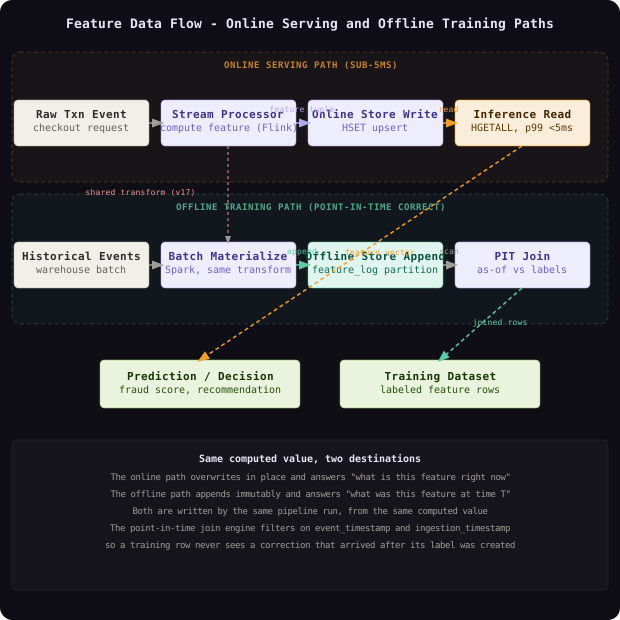
Sharding both stores by the same entity_id, even though one is a Redis hash slot and the other is a Parquet partition, keeps the mental model consistent for every engineer building on top of the feature store: one entity’s data lives in one place in both worlds, which makes reasoning about consistency between them tractable instead of an ongoing archaeology project.
Key Algorithms and Protocols
Point-in-Time Correct Resolution with Version Pinning
Point-in-time correctness and feature versioning are not independent concerns, a training job asking “what was this feature at time T” also has to ask “under which version of this feature’s definition.” The resolution algorithm looks up the model’s bound feature_version first, then applies the point-in-time filter within that version only, falling back deliberately, and visibly, rather than silently, if no value exists under the exact bound version.
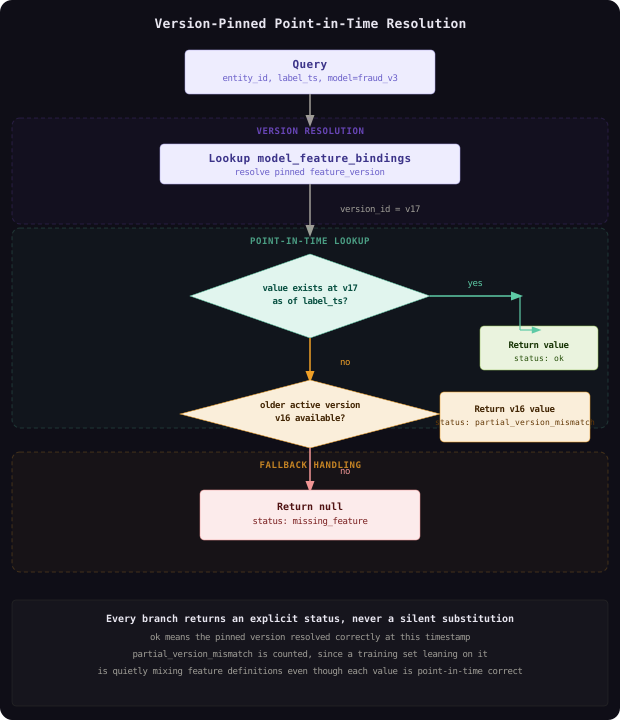
# Resolves a feature value for one entity, honoring both the model's pinned
# feature version and the point-in-time correctness guard
from typing import Optional

def resolve_feature(
    entity_id: str,
    label_timestamp: int,
    feature_name: str,
    model_binding: dict,          # {"version_id": ..., "fallback_version_id": ...}
    timelines_by_version: dict,   # {version_id: {entity_id: [FeatureRecord, ...]}}
) -> dict:
    pinned_version = model_binding["version_id"]
    pinned_timeline = timelines_by_version.get(pinned_version, {}).get(entity_id, [])
    match = lookup_as_of(pinned_timeline, label_timestamp)
    if match is not None:
        return {
            "feature_name": feature_name,
            "value": match.value,
            "resolved_version": pinned_version,
            "status": "ok",
        }

    fallback_version = model_binding.get("fallback_version_id")
    if fallback_version is not None:
        fallback_timeline = timelines_by_version.get(fallback_version, {}).get(entity_id, [])
        fallback_match = lookup_as_of(fallback_timeline, label_timestamp)
        if fallback_match is not None:
            return {
                "feature_name": feature_name,
                "value": fallback_match.value,
                "resolved_version": fallback_version,
                "status": "partial_version_mismatch",
            }

    return {
        "feature_name": feature_name,
        "value": None,
        "resolved_version": None,
        "status": "missing_feature",
    }
The status field is not cosmetic, partial_version_mismatch rows should be counted and surfaced, since a training set with a meaningful fraction of fallback-resolved features is quietly training against a mix of feature definitions, which is its own subtle form of skew even though every individual value was point-in-time correct.
The property that makes version-pinned resolution safe is that a fallback is always explicit and counted, never silent. A model that trained against version 17 and later scores against version 18 in production without anyone noticing is a training-serving skew bug wearing a versioning system’s clothes.
Feature Freshness Scoring
A feature group’s staleness is only meaningful relative to its own SLO, a 10-minute-old value is fine for a daily aggregate and dangerously stale for a real-time fraud signal, so freshness has to be scored per feature group rather than measured as one global staleness number.
# Computes a per-feature-group freshness score against its configured SLO
# and flags violations before they reach the online store's consumers
from datetime import datetime, timezone

def staleness_seconds(last_materialized_at: datetime, now: datetime = None) -> float:
    now = now or datetime.now(timezone.utc)
    return (now - last_materialized_at).total_seconds()

def freshness_score(staleness_s: float, slo_seconds: float) -> float:
    # 1.0 = perfectly fresh, 0.0 = exactly at the SLO boundary, negative = breached
    if slo_seconds <= 0:
        raise ValueError("slo_seconds must be positive")
    return 1.0 - (staleness_s / slo_seconds)

def evaluate_feature_group_freshness(materialization_state: dict, registry: dict) -> list:
    # materialization_state: {feature_group: last_materialized_at}
    # registry: {feature_group: freshness_slo_seconds}
    violations = []
    now = datetime.now(timezone.utc)
    for group, last_run in materialization_state.items():
        slo = registry[group]
        staleness = staleness_seconds(last_run, now)
        score = freshness_score(staleness, slo)
        if score <= 0:
            violations.append({
                "feature_group": group,
                "staleness_seconds": staleness,
                "slo_seconds": slo,
                "breach_ratio": staleness / slo,
            })
    return violations
breach_ratio above 1.0 sorts violations by how badly they miss their own SLO rather than by raw seconds, so a 40-second miss on a 30-second real-time SLO surfaces above a 4-minute miss on an 8-hour batch SLO, matching operational urgency to the feature’s actual usage rather than to the size of the number.
The property that makes freshness scoring actionable is normalizing staleness by each feature group’s own SLO instead of comparing raw ages across groups with wildly different freshness requirements. An absolute staleness threshold either pages on-call for harmless batch delays or misses a real-time feature going stale for minutes.
Training-Serving Skew Detection
Even with a shared transformation and a dual-write pipeline, skew can still creep in through infrastructure differences, a serialization library upgraded on one path and not the other, or a subtle timezone bug in a backfill. The defense is a continuous statistical check comparing what the offline store computed against what the online store is actually serving for the same entities.
# Population Stability Index between offline-computed and online-served
# feature distributions, flags training-serving skew before it reaches a model
import math

def bucketize(values: list, edges: list) -> list:
    counts = [0] * (len(edges) - 1)
    for v in values:
        placed = False
        for i in range(len(edges) - 1):
            if edges[i] <= v < edges[i + 1]:
                counts[i] += 1
                placed = True
                break
        if not placed:
            counts[-1] += 1
    return counts

def population_stability_index(offline_values: list, online_values: list, edges: list) -> float:
    offline_counts = bucketize(offline_values, edges)
    online_counts = bucketize(online_values, edges)
    offline_total = sum(offline_counts) or 1
    online_total = sum(online_counts) or 1
    psi = 0.0
    for off_c, on_c in zip(offline_counts, online_counts):
        off_pct = max(off_c / offline_total, 1e-6)
        on_pct = max(on_c / online_total, 1e-6)
        psi += (on_pct - off_pct) * math.log(on_pct / off_pct)
    return psi

def skew_alert(psi: float) -> str:
    if psi < 0.1:
        return "stable"
    if psi < 0.25:
        return "moderate_drift"
    return "severe_skew"
Running this check every 6 hours per feature, as configured in the pipeline’s skew_check block, catches divergence within hours instead of waiting for a model’s live accuracy to degrade, which can take weeks to become statistically visible against normal business variance.
The property that makes PSI useful here is that it is symmetric and bounded, unlike a raw difference of means it catches distributional shifts, more zeros, a fatter tail, a shifted median, that a simple mean comparison would average away and miss entirely.
Scaling and Performance
The system scales along three largely independent axes: the stream processing layer, partitioned by entity key so materialization throughput scales with consumer parallelism; the Online Feature Store, sharded across a Redis Cluster whose hash slot space scales independently of ingestion volume; and the Offline Feature Store and Point-in-Time Join Engine, which scale with the size of the Spark or warehouse compute cluster reading from object storage.
Capacity Estimation:

Given:
  - 50,000,000 distinct entities (users, merchants, devices) tracked
  - 5,000 registered features across 200 feature groups
  - 10,000 feature-update events/sec sustained via streaming ingestion
  - Peak online inference traffic: 300,000 requests/sec, ~20 features read per request
  - Offline feature log retention: 2 years

Online read path:
  Feature lookups/sec (peak): 300,000 * 20 = 6,000,000/sec
  Average feature vector size: ~600 bytes (20 features + metadata)
  Hot dataset resident in memory: 50,000,000 entities * 600 bytes ~= 30GB
  Redis Cluster sized at ~120,000 ops/sec/node with replicas: ~50 primary shards + 50 replicas

Streaming write path:
  Feature-update events/sec: 10,000/sec sustained, ~8x at peak ~= 80,000/sec
  Bytes/event (~5 features touched, ~40 bytes each): ~200 bytes
  Write bandwidth to online store: 80,000 * 200 bytes ~= 16MB/sec sustained at peak

Offline storage:
  Feature log rows/day: 10,000/sec * 86,400 ~= 864,000,000 rows/day
  Row size (entity_id, feature_name, value, 2 timestamps): ~80 bytes raw, ~25 bytes Parquet compressed
  Daily volume: 864,000,000 * 25 bytes ~= 21.6GB/day compressed
  2-year retention: 21.6GB * 730 ~= 15.8TB compressed feature log

Point-in-time join throughput (nightly training set build):
  Label rows in a typical training run: 500,000,000
  Feature lookups per label row: 40 features joined
  Total lookups: 500,000,000 * 40 = 20,000,000,000
  Required sustained rate to finish inside a 4-hour window: 20,000,000,000 / 14,400s ~= 1.4M lookups/sec
The read-to-write ratio at the online store is heavily read-skewed, roughly 75 online reads for every materialization write at this scale, so the cluster’s replica count is sized primarily for read throughput rather than write durability, and read traffic is spread across replicas while writes go only to primaries. Client-side caching of the hottest few thousand entity keys, refreshed on a short TTL, absorbs the skew from viral merchants or bot traffic without adding load to the cluster itself.
LinkedIn’s Venice and Uber’s Michelangelo both report that online read volume dwarfs write volume by one to two orders of magnitude in production feature stores, which is why both platforms size their serving layer around read fan-out and replica placement rather than write throughput, the dominant bottleneck almost never sits on the write path.
Failure Modes and Recovery
| Failure | Detection | Impact | Recovery |
|---|---|---|---|
| Stream processor consumer lag spike | Consumer lag/offset delta alarm on the ingestion topic | Online features grow stale beyond their freshness SLO | Autoscale consumer parallelism, apply backpressure-aware batching, page on-call once staleness exceeds SLO |
| Online store node failure | Cluster gossip failure detection, health checks | Reads for entities on that node’s hash slots fail or fall back to a replica | Automatic failover promotes a replica to primary; the cluster resumes serving those slots within seconds |
| Late-arriving correction changes a past feature value | Ingestion-timestamp-far-after-event-timestamp flagged by the pipeline monitor | Risk of label leakage if a join ignores ingestion_timestamp | Point-in-time joins always filter on ingestion_timestamp <= label_timestamp, so late corrections are correctly excluded from already-generated training sets |
| Registry publish introduces a breaking schema change | Schema validation at publish time against active model_feature_bindings | Consuming models fail deserialization or silently receive a wrong-typed feature | Reject the publish until bindings are migrated; run old and new versions in parallel during a transition window |
| Offline batch materialization job fails mid-run | Orchestrator failure alert, row-count sanity check against the upstream source | The offline feature_log has a gap for that partition | Orchestrator retries with an idempotent partition overwrite; point-in-time joins are blocked from reading the incomplete partition until it is healed |
| Clock skew between stream processing nodes | NTP drift monitor comparing event_timestamp against server-observed bounds | Freshness scoring and point-in-time joins compute against wrong timestamps | Reject and quarantine events with timestamps outside an acceptable skew window, alert, backfill once the source is corrected |
The most common operational mistake is disabling the skew-check job during an incident to “reduce noise” and forgetting to re-enable it. Skew detection is not an optional nicety layered on top of the pipeline, it is the only thing standing between a quiet infrastructure change and a model degrading for weeks before anyone notices in production metrics.
Comparison of Approaches
| Approach | Latency | Complexity | Failure Mode | Best Fit |
|---|---|---|---|---|
| Redis Cluster (in-memory, hash per entity) | Sub-millisecond to low single-digit ms | Medium | Node failure needs failover; memory pressure evicts under-TTL’d keys | High QPS, sub-5ms SLA, dataset that fits comfortably in memory |
| Managed key-value store (e.g. DynamoDB) | Mid single-digit ms, network hop to a managed service | Low, mostly managed operations | Throttling under a hot partition key, cold-start latency on traffic bursts | Teams that want to trade a few milliseconds of latency for zero infrastructure ownership |
| Wide-column store (e.g. Cassandra, ScyllaDB) | Low single-digit ms | High, tuning compaction and repair | Read amplification from tombstones or compaction lag | Datasets that exceed a memory-resident budget, or very write-heavy feature update patterns |
| Embedded store on the inference host (e.g. a RocksDB sidecar synced from the stream) | Sub-millisecond, no network hop at all | High, requires a sync/replication protocol per host | Staleness when the local sidecar’s sync lags the source of truth | Ultra-low-latency needs where a brief staleness window is an acceptable tradeoff |
| Direct query to the production transactional database | Tens of milliseconds, contends with live transactional load | Low, nothing new to build | Couples inference availability to OLTP availability, cannot scale independently | Prototyping only, never a production-scale online serving path |
For a fraud and recommendations platform at this scale, a sharded Redis Cluster is the right default. It is the only option here that reliably clears a 5-millisecond p99 at hundreds of thousands of requests per second while staying operationally simple enough for one team to run. An embedded sidecar store is worth revisiting only once sub-millisecond latency becomes a hard requirement and the team is willing to own a custom sync protocol; a managed key-value store is worth revisiting once infrastructure ownership, not latency, becomes the binding constraint.
Key Takeaways
- Online and offline stores solve different problems on purpose: the online store optimizes for a fast, current read; the offline store optimizes for a complete, precisely time-stamped history, and neither should be asked to do the other’s job.
- A single shared transformation prevents skew structurally: dual-writing one computed value to both stores from one pipeline run closes off the most common source of training-serving skew before it can happen.
- Point-in-time correctness needs two timestamps, not one:
event_timestampsays what happened,ingestion_timestampsays when the system actually learned it, and only the second one can gate what a training job is allowed to see. - Feature versioning makes old models reproducible: pinning a model to an exact
feature_version_id, not a feature name, is what lets a model trained six months ago keep scoring correctly today. - Freshness is only meaningful relative to a feature’s own SLO: a global staleness threshold either pages needlessly on slow batch features or misses a real-time feature going stale.
- Skew detection has to run continuously, not just at model launch: infrastructure drift, not just logic drift, can reintroduce skew long after a pipeline was originally verified correct.
- Sharding both stores by the same entity key keeps the mental model simple: even across two physically different storage engines, one entity’s data living in one logical place makes consistency reasoning tractable.
- Human-verifiable fallbacks beat silent ones: a version-pinned lookup that falls back to an older feature version must say so explicitly, or a model quietly trains and scores against inconsistent definitions.
The counter-intuitive lesson is that the hardest part of this system is not the low-latency serving path, sharded in-memory key-value stores are a well-understood problem. It is resisting the urge to let the offline and online paths evolve independently, because every hour saved by letting two teams implement a feature twice is repaid later as an unexplained model regression that takes weeks to trace back to a single rounding difference between two code paths that were never supposed to diverge.
Frequently Asked Questions
Q: Why not just query the production database for features at inference time instead of building a separate online store?
A: A transactional database is optimized for row-level reads and writes against a normalized schema, not for assembling a 20-to-40-feature flat vector under a 5-millisecond budget while also absorbing live write traffic from the application itself. Querying it directly also couples inference availability to the transactional system’s availability and load, so a checkout traffic spike would degrade both payments and fraud scoring simultaneously instead of scaling independently.
Q: Why not skip the offline store entirely and just replay the online store’s history to build training sets?
A: The online store overwrites values in place and expires entities via TTL, so it has no memory of what a feature looked like last month, only what it looks like now. Reconstructing “what did we know at time T” requires an append-only, time-stamped log that was designed for that exact query pattern from the start, which is precisely what the offline store is and the online store deliberately is not.
Q: How does the point-in-time join engine actually prevent leakage from late-arriving corrections?
A: By filtering on both event_timestamp <= label_timestamp and ingestion_timestamp <= label_timestamp. The first condition alone is not sufficient, because a correction can be logically dated in the past while only becoming queryable after the label was generated; the second condition is what excludes information the system had not actually learned yet at label time.
Q: Why bother with feature versioning if the transformation code already lives in source control?
A: Source control tells you what the code looks like today, not what specific version of that code produced a specific historical value. Without an explicit feature_version_id bound to a model, there is no way to answer “was this model trained and later scored against the same feature definition” without manually diffing commit history against training run timestamps, which does not scale past a handful of models.
Q: What happens when a feature’s transformation logic needs to change, do you rewrite the historical feature_log?
A: No, you publish a new feature_version and let both versions coexist. The pipeline dual-materializes under the new version going forward, existing model bindings keep resolving against their pinned older version, and only once every consumer has migrated does the old version get marked inactive. Rewriting history would break every past training snapshot’s reproducibility guarantee.
Q: Why not just rely on a shared code library between the batch and streaming pipelines instead of a strict registry plus dual-write pattern?
A: A shared library helps but does not fully close the gap, two different runtimes, a Spark batch job and a Flink streaming job, can still run different library versions, different serialization behavior, or different null-handling defaults even when calling what is nominally the same function. The registry adds an explicit, monitored version pin and a continuous skew-detection job as a safety net that catches exactly the class of drift a shared library alone cannot guarantee against.
Interview Questions
Q: Design the online serving path for a feature store that must return feature vectors in under 5ms at 300,000 requests per second. What storage engine would you choose and why?
Expected depth: Discuss in-memory key-value stores like a sharded Redis Cluster, hashing entity keys across a fixed slot space, using read replicas to absorb read-heavy traffic, avoiding cross-shard multi-key operations by keeping one entity’s vector in a single hash, and the latency-versus-operational-burden tradeoff against a managed alternative like DynamoDB.
Q: How would you prevent training-serving skew when the same feature is computed by both a batch job and a real-time streaming job?
Expected depth: Discuss defining the transformation once in a shared, versioned registry entry, dual-writing to both stores from a single pipeline run instead of maintaining two independent implementations, and layering a continuous statistical skew check, such as PSI, comparing offline-computed and online-served distributions to catch infrastructure-level drift that code sharing alone cannot prevent.
Q: Walk through how you would implement a point-in-time correct join for a training dataset with 500 million label rows.
Expected depth: Discuss as-of join semantics filtering on event_timestamp <= label_timestamp, why ingestion_timestamp is also required to exclude late corrections, building per-entity sorted timelines for efficient binary search versus a naive O(n*m) comparison, and how the same logic maps to a LATERAL join for parallel execution across a Spark or warehouse cluster.
Q: A specific feature group keeps breaching its freshness SLO in production. How would you detect and diagnose this?
Expected depth: Discuss scoring staleness relative to each feature group’s own configured SLO rather than a global threshold, distinguishing a pipeline bug (a crashed transformation) from an infrastructure bottleneck (consumer lag, a hot partition), and the tradeoff between autoscaling consumer parallelism versus tightening the SLO if the underlying source data simply cannot arrive faster.
Q: How would you design feature versioning so a model trained six months ago can still be scored consistently today?
Expected depth: Discuss a feature_versions table with a content hash to detect silent code drift, a model_feature_bindings table pinning an exact version_id per model, an explicit and monitored fallback path when a pinned version has no value for a given entity and timestamp, and a deprecation process for retiring old feature versions only after every bound model has migrated.
Premium Content
Unlock the full article along with everything else in the archive — all in one place.