Build a HIPAA-Compliant Tamper-Evident Audit Log
security data-engineering reliability
System Design Deep Dive
HIPAA Tamper-Evident Audit Log
Every PHI access logged forever, and tampering detectable in minutes, not at the next audit.
A paper medical chart used to have one rule that made it trustworthy in court: a nurse signed and dated every entry in ink, and if an entry needed correcting, she drew a single line through the old text, initialed next to it, and wrote the correction below. She never got to erase anything. Decades later, an auditor could flip through that chart and see, in the handwriting itself, exactly what happened and in what order, including every mistake and every fix. The trustworthiness did not come from locking the chart in a safe. It came from the fact that altering history left a visible scar.
A HIPAA-compliant tamper-evident audit log is that ink-and-strikethrough discipline rebuilt in software, at a scale no nurse’s handwriting could ever reach. Every time a clinician opens a chart, a billing clerk exports a record, or a background job syncs patient data between systems, that touch has to be captured, and the capture itself has to be provably unalterable, not just policy-protected. At a healthcare network running 500 facilities, 50 million patient records, and roughly 200,000 clinical and administrative staff accounts, that adds up to on the order of 20,000 audit events a second during shift-change bursts and overnight batch reconciliation, all of which has to be retained for a minimum of six years under 45 CFR 164.316(b)(2)(i), and every single one of those events has to remain queryable and independently verifiable for the entire retention window.
The naive approach is to write audit rows into a normal table in the same application database that runs the EHR. That collapses immediately under one uncomfortable fact: the audit log’s entire job is to catch misuse of privileged access, including misuse by someone who already has database administrator rights to that same database. An attacker, or a rogue insider, who has compromised the EHR’s data tier can simply UPDATE or DELETE the very rows meant to catch them, and normal database durability guarantees do nothing to stop that, because deletion through the front door is not a failure, it is a permitted operation. Write-once files on a regular filesystem fail for the same underlying reason: filesystem permissions can be reconfigured by anyone with root, and nothing detects a silently altered or removed file until someone happens to notice. Encrypting each record does not solve this either, since encryption protects confidentiality, not integrity; an attacker who can replace one ciphertext blob with another faces no additional obstacle from encryption alone.
The forces in tension are throughput, storage economics, and query performance. Every audit event needs a cryptographic operation before it is durable, but that operation cannot add meaningful latency to the clinical transaction that triggered it. Six-plus years of retention across hundreds of millions of daily events is a genuinely large storage bill, so the system needs a cheap cold-storage lifecycle without ever compromising immutability. And auditors need fast, filtered search by patient, actor, facility, and date range, which is exactly the kind of workload an append-only, write-once log is bad at serving directly. We need to solve for tamper evidence at the byte level through hash chaining, storage that physically cannot be overwritten through WORM guarantees, periodic Merkle anchoring so a single record’s integrity can be proven without replaying millions of prior events, and a fast query index that is explicitly disposable and never becomes a second source of truth.
Requirements and Constraints
Functional Requirements
- Capture every PHI access and modification event (read, create, update, delete, print, export, break-glass override) with actor, patient, resource, action, facility, and timestamp
- Append events into an immutable, hash-chained log that exposes no update or delete API surface at all, not even to system administrators
- Periodically anchor the chain into signed Merkle tree roots so any single record’s inclusion, and the chain’s continuity, can be verified independently of replaying the entire history
- Store sealed log segments in WORM (write once, read many) storage with a per-segment retention lock
- Give auditors a fast, filterable query interface across patient, actor, date range, action type, and facility, without that query path ever becoming the system of record
- Detect and alert on any evidence of tampering: a broken hash chain, a missing sequence number, or a signature that fails verification
- Enforce a configurable retention policy with support for legal hold, extending retention indefinitely for records under active litigation or investigation
Non-Functional Requirements
- Ingestion latency: p99 under 200ms per event, and the audit write must never block or slow the originating clinical transaction
- Throughput: sustain 3,500 events/sec on average, with bursts to 20,000 events/sec during shift changes and nightly batch reconciliation
- Durability: effectively zero data loss on the WORM tier; once an event is acknowledged, it must survive any single-region failure
- Retention: a minimum of 6 years per 45 CFR 164.316(b)(2)(i), extendable to indefinite under legal hold
- Query latency: p95 under 2 seconds for auditor searches spanning the full retention window
- Availability: 99.99% for the ingestion path; the system may fail loudly and reject a write, but must never silently drop one
- Verifiability: proving a single record’s authenticity via a Merkle proof must complete in under 50ms, independent of how many billions of records precede it
Constraints and Assumptions
- We are not designing the source EHR or clinical systems that emit events, only the audit trail that receives and protects them
- Field-level encryption of sensitive payload fields (minimizing PHI exposure inside the audit log itself) is treated as a separate concern; this post focuses on integrity and tamper evidence, not confidentiality key management
- Events arrive over an already-authenticated internal channel (mutual TLS between each EHR instance and the ingestion gateway); we do not design client authentication itself
- Downstream SIEM alerting and paging on a detected tamper event is assumed to exist; we design the detection signal, not the incident-response tooling
High-Level Architecture
The system has six major components: the Audit Ingestion Gateway, the Hash-Chain Log Writer, the WORM Storage Tier, the Merkle Anchoring Service, the Query Index, and the Verifier and Auditor API.
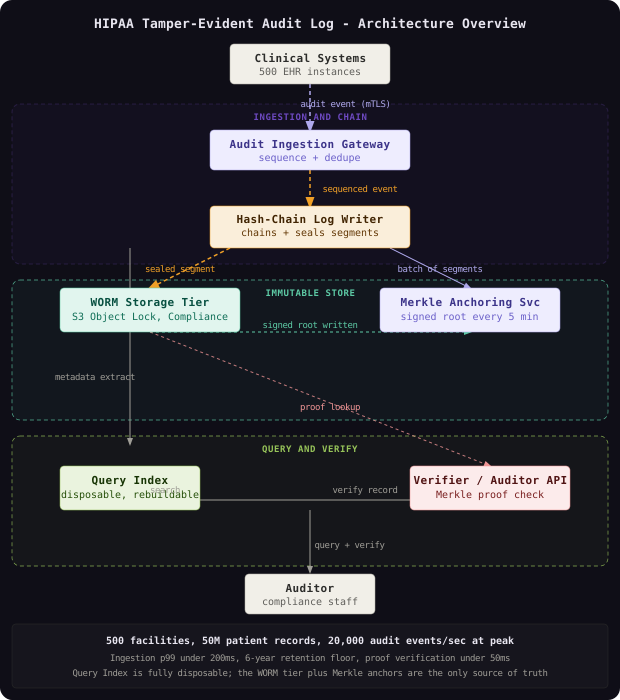
Every clinical system across 500 facilities sends an audit event over mutual TLS to the Audit Ingestion Gateway the moment a PHI record is touched. The Gateway validates the event’s shape, deduplicates retries using an idempotency key, and assigns a server-side monotonic sequence number scoped to that facility’s chain, since trusting a client-supplied timestamp for ordering would let a compromised source system claim any order it wants. The Hash-Chain Log Writer takes the sequenced event, computes a chained hash that links it to every prior event in that facility’s history, and batches events into a sealed segment every two seconds or 50,000 events, whichever comes first. Sealed segments flush to the WORM Storage Tier under an Object Lock retention policy that even the storage account’s own root credentials cannot shorten.
In parallel, a lightweight metadata extract (patient ID, actor ID, action, facility, timestamp, and a pointer back to the segment and offset) flows to the Query Index, which exists purely for fast auditor search and holds no data that cannot be rebuilt from the WORM segments. Every five minutes, the Merkle Anchoring Service builds a Merkle tree over the segments sealed in that interval for each facility, signs the resulting root with an HSM-backed key, and writes that root to a separate, independently secured anchor store. The Verifier and Auditor API ties it together: an auditor searches the Query Index for candidate records, then requests a proof for any one of them, and the Verifier checks that proof against the signed Merkle root without ever needing to replay the full chain.
Data moves through two loops running at very different rhythms: a continuous ingestion loop touching the Gateway, the Log Writer, and WORM storage tens of thousands of times a second, and a much slower anchoring loop that runs once every five minutes per facility and produces a single 32-byte root that stands in for everything written since the last anchor.
The single most important architectural decision is that the Query Index and the tamper-evident log are two entirely separate systems joined by a one-way data flow. The index can be rebuilt, degraded, or wiped without losing a single byte of evidentiary integrity, because it is never the source of truth. The moment a query convenience layer becomes load-bearing for integrity, the entire tamper-evidence guarantee quietly disappears.
The Audit Ingestion Gateway
This component’s job is to accept audit events from every clinical system, at whatever rate they arrive, without ever becoming a place where an event can be lost, duplicated, or reordered in a way that breaks the chain downstream.
A reasonable first instinct is to treat this as a generic message queue producer and move on. That instinct undersells two problems specific to a tamper-evident chain: network retries from an EHR instance can deliver the same event twice, and if two events race for the same sequence slot, the chain forks silently instead of failing loudly. The Gateway assigns a server-side monotonic sequence number per facility (never trusting a client-supplied one) and deduplicates on a client-generated event ID, so a retried request is safely absorbed rather than double-counted.
# Audit Ingestion Gateway: idempotent event acceptance with per-facility sequencing
# Demonstrates: dedupe on client event_id, atomic sequence assignment via Redis
import time

class DuplicateEvent(Exception):
    pass

class MalformedAuditEvent(Exception):
    pass

REQUIRED_FIELDS = ("event_id", "facility_id", "actor_id", "patient_id", "action", "resource_type", "occurred_at")

def validate_event(event: dict) -> None:
    missing = [f for f in REQUIRED_FIELDS if f not in event]
    if missing:
        raise MalformedAuditEvent(f"missing fields: {missing}")
    if event["action"] not in ("read", "create", "update", "delete", "print", "export", "break_glass"):
        raise MalformedAuditEvent(f"unknown action: {event['action']}")

SEQUENCE_SCRIPT = """
local dedupe_key = KEYS[1]
local seq_key = KEYS[2]
local event_id = ARGV[1]
local ttl = tonumber(ARGV[2])

if redis.call('SET', dedupe_key, '1', 'NX', 'EX', ttl) == false then
  return -1
end
return redis.call('INCR', seq_key)
"""

def assign_sequence(redis_client, facility_id: str, event_id: str) -> int:
    dedupe_key = f"audit:dedupe:{facility_id}:{event_id}"
    seq_key = f"audit:seq:{facility_id}"
    seq = redis_client.eval(SEQUENCE_SCRIPT, keys=[dedupe_key, seq_key], args=[event_id, 86400])
    if seq == -1:
        raise DuplicateEvent(event_id)
    return int(seq)

def ingest(redis_client, event: dict, now: float | None = None) -> dict:
    validate_event(event)
    event["gateway_received_at"] = now or time.time()
    event["sequence_no"] = assign_sequence(redis_client, event["facility_id"], event["event_id"])
    return event
Think of this the way a bank date-stamps and numbers every deposit slip before it reaches the vault: the number itself proves nothing was skipped, and it is assigned by the bank, never written by the depositor. If facilities were allowed to self-assign sequence numbers or timestamps, clock skew across 500 sites would make causal ordering unreliable, and a compromised source system could simply claim whatever position in history was convenient for it.
Relaxing schema validation “temporarily” to avoid rejecting a misbehaving EHR integration is the single most common way a tamper-evident log quietly stops being trustworthy. A malformed event that slips through with an empty patient_id or an out-of-range action becomes a permanent, unfixable gap in the chain the moment it is hashed, because the record itself cannot be edited afterward, by design.
The Hash-Chain Log Writer
This component’s job is to turn a stream of individually sequenced events into a single unbroken cryptographic chain where altering or deleting any past record becomes detectable, not just theoretically but immediately upon the next verification pass.
The chain works by making every record’s hash depend on the hash of the one before it: H(n) = SHA256(H(n-1) || canonical_bytes(record_n)), with a fixed genesis hash H(0) defined per facility at deployment time. Canonicalizing the record bytes matters more than it sounds: JSON key ordering, floating-point formatting, and timezone representation all need a single deterministic encoding, or the same logical record could hash two different ways depending on which library serialized it.
# Hash-Chain Log Writer: canonical encoding and chained hash computation
# Demonstrates: deterministic canonicalization, sequential hash chaining, segment sealing
import hashlib
import json
import struct

GENESIS_HASH = bytes(32)  # facility-specific genesis hash, provisioned once at deployment

def canonical_bytes(record: dict) -> bytes:
    # Sort keys, force UTC ISO-8601 timestamps, and use compact separators so the
    # same logical event always produces identical bytes regardless of producer.
    normalized = {
        "event_id": record["event_id"],
        "facility_id": record["facility_id"],
        "actor_id": record["actor_id"],
        "patient_id": record["patient_id"],
        "action": record["action"],
        "resource_type": record["resource_type"],
        "sequence_no": record["sequence_no"],
        "occurred_at": record["occurred_at"],
    }
    return json.dumps(normalized, sort_keys=True, separators=(",", ":")).encode("utf-8")

def next_chain_hash(prev_hash: bytes, record: dict) -> bytes:
    if len(prev_hash) != 32:
        raise ValueError("prev_hash must be a 32-byte SHA-256 digest")
    return hashlib.sha256(prev_hash + canonical_bytes(record)).digest()

class SegmentBuilder:
    """Accumulates chained records until a time or size threshold triggers a seal."""

    def __init__(self, facility_id: str, prev_hash: bytes = GENESIS_HASH):
        self.facility_id = facility_id
        self.prev_hash = prev_hash
        self.records: list[dict] = []
        self.leaf_hashes: list[bytes] = []

    def append(self, record: dict) -> bytes:
        chain_hash = next_chain_hash(self.prev_hash, record)
        record["chain_hash"] = chain_hash.hex()
        self.records.append(record)
        self.leaf_hashes.append(chain_hash)
        self.prev_hash = chain_hash
        return chain_hash

    def should_seal(self, max_records: int = 50_000) -> bool:
        return len(self.records) >= max_records
Picture a paper ledger where each new page’s opening line repeats a checksum of the page before it. Tear one page out, and the very next page’s opening line no longer matches anything, instantly, without anyone needing to re-read the whole ledger from the start. That is exactly what hash chaining buys: without it, deleting record 4,000,000 out of 300 million just leaves a silent hole that nothing detects. With it, deleting or altering a single record breaks every hash computed after it.
Certificate Transparency logs (RFC 6962) use precisely this per-entry hashing plus periodic Merkle root model to make certificate issuance publicly auditable and tamper-evident. Amazon QLDB’s journal applies the same hash-chain-plus-periodic-digest idea specifically for tamper-evident ledgers, which is why it reads as a natural fit whenever “prove nothing was silently changed” is the actual requirement, not just “store data reliably.”
WORM Storage and Retention
This component’s job is to guarantee that once a segment is sealed, nothing, not a misconfigured IAM policy, not a compromised operations account, not even the cloud account’s own root user, can modify or delete it before its retention period expires.
The instinctive shortcut is to rely on IAM permissions alone: deny s3:DeleteObject to everyone except a tightly scoped service role. The problem is that IAM policies are themselves mutable by anyone with sufficient permission, including an attacker who has escalated privileges or an insider with admin access, so an IAM-only guarantee is really just “nobody has changed the policy yet,” not a structural guarantee. Object Lock in Compliance mode is a different kind of promise: once a retention date is set on an object, it genuinely cannot be shortened, overwritten, or deleted before that date by any principal, including the account root, until the retention period lapses.
# WORM Storage Tier: sealing a segment under S3 Object Lock Compliance mode
# Demonstrates: immutable retention lock, legal hold as a separate override flag
import boto3
from datetime import datetime, timedelta, timezone

s3 = boto3.client("s3")

RETENTION_YEARS = 6  # minimum per 45 CFR 164.316(b)(2)(i)

def seal_segment(bucket: str, key: str, segment_bytes: bytes, legal_hold: bool = False) -> None:
    retain_until = datetime.now(timezone.utc) + timedelta(days=365 * RETENTION_YEARS)
    s3.put_object(
        Bucket=bucket,
        Key=key,
        Body=segment_bytes,
        ObjectLockMode="COMPLIANCE",
        ObjectLockRetainUntilDate=retain_until,
        ObjectLockLegalHoldStatus="ON" if legal_hold else "OFF",
        ContentType="application/octet-stream",
    )

def extend_legal_hold(bucket: str, key: str) -> None:
    # Legal hold has no expiry of its own and must be explicitly lifted by
    # compliance staff once litigation or investigation concludes.
    s3.put_object_legal_hold(
        Bucket=bucket,
        Key=key,
        LegalHold={"Status": "ON"},
    )
Sealing a segment this way is like locking a document in a bank safety deposit box with a mechanical time lock: even the bank manager cannot open the box before the timer expires, no matter what credentials they hold. Retention and legal hold are deliberately separate controls: the 6-year ObjectLockRetainUntilDate is a fixed floor that applies uniformly, while ObjectLockLegalHoldStatus is an independent, indefinite override that compliance staff can apply to specific segments under active litigation without touching the retention date of anything else.
Governance mode looks identical to Compliance mode in the AWS console but allows any principal holding s3:BypassGovernanceRetention to delete or overwrite a locked object early. For a HIPAA audit trail, that permission existing anywhere in the account is the exact failure mode this whole tier exists to prevent. Compliance mode, not Governance mode, is the only choice that matches the requirement.
The Merkle Anchoring Service
This component’s job is to shrink “prove this one record has not been tampered with” from “replay millions of hash computations from genesis” down to “check a single 32-byte root and a handful of sibling hashes.”
Without a Merkle anchor, verifying record 4,000,000 in a facility’s chain of 300 million events means recomputing every hash from H(0) forward, an O(n) operation that becomes impractical the moment a chain crosses even a few million entries, let alone the tens of billions accumulated over a 6-year retention window. Every five minutes, the Anchoring Service takes the chain hashes sealed in that interval for each facility, builds a Merkle tree with them as leaves, and signs the resulting root with an Ed25519 key held in an HSM.
# Merkle Anchoring Service: batch root computation over a facility's interval segments
# Demonstrates: pairwise-hash tree construction, odd-leaf duplication, root signing
import hashlib

def merkle_parent(left: bytes, right: bytes) -> bytes:
    return hashlib.sha256(b"\x01" + left + right).digest()  # 0x01 domain-separates internal nodes

def build_merkle_root(leaf_hashes: list[bytes]) -> bytes:
    if not leaf_hashes:
        raise ValueError("cannot build a Merkle tree over zero leaves")
    level = list(leaf_hashes)
    while len(level) > 1:
        if len(level) % 2 == 1:
            level.append(level[-1])  # duplicate the last odd leaf, standard Merkle convention
        level = [merkle_parent(level[i], level[i + 1]) for i in range(0, len(level), 2)]
    return level[0]

def anchor_interval(signing_key, facility_id: str, interval_start: int, leaf_hashes: list[bytes]) -> dict:
    root = build_merkle_root(leaf_hashes)
    signature = signing_key.sign(root).signature
    return {
        "facility_id": facility_id,
        "interval_start": interval_start,
        "leaf_count": len(leaf_hashes),
        "root": root.hex(),
        "signature": signature.hex(),
    }
A Merkle tree is a family tree of checksums: to prove one person’s identity is genuine, you only need the chain of ancestors up to the root, not the entire tree. The signed root itself is written to a storage location independently secured from the main WORM bucket, in a separate account with a separate key policy, so that compromising the ingestion path alone is not enough to forge a matching anchor.
Bitcoin’s block headers and Certificate Transparency logs both use Merkle trees for exactly this membership-proof property: a client can verify a single transaction or certificate belongs to a dataset containing millions of entries by checking a proof of logarithmic size, never downloading the full dataset. The same math applies here at a much smaller, healthcare-appropriate scale.
The Query Index
This component’s job is to give auditors fast, filterable search across patient, actor, facility, date range, and action type, without that search path ever becoming a place data can be quietly rewritten.
The tempting simplification is to make the search index itself the audit trail, since an OpenSearch or Elasticsearch cluster is genuinely pleasant to query and the WORM tier is not. That simplification is fatal: Elasticsearch documents are trivially mutable by anyone with index write access, which means an attacker who compromises the indexing pipeline (not even the WORM storage itself) could silently rewrite what auditors see, with zero cryptographic protection standing in the way. The index instead holds only a metadata extract, structured for search, alongside a pointer back to the exact segment and byte offset where the authoritative, hash-chained record lives.
{
  "mappings": {
    "properties": {
      "event_id":       { "type": "keyword" },
      "facility_id":     { "type": "keyword" },
      "actor_id":        { "type": "keyword" },
      "patient_id":       { "type": "keyword" },
      "action":            { "type": "keyword" },
      "resource_type":      { "type": "keyword" },
      "occurred_at":         { "type": "date" },
      "sequence_no":          { "type": "long" },
      "segment_id":            { "type": "keyword" },
      "segment_offset":         { "type": "long" },
      "chain_hash":              { "type": "keyword" }
    }
  },
  "settings": {
    "number_of_shards": 3,
    "number_of_replicas": 1
  }
}
Think of it as a library’s card catalog: the card helps a reader find the right shelf and volume fast, but the actual archived book, and its authenticity, lives elsewhere. If the catalog is lost or corrupted, the library rebuilds it from the archive; nobody treats the catalog cards as the primary record. Because the index holds nothing that cannot be regenerated by replaying WORM segments, it can be dropped and rebuilt entirely, sharded per month for query locality, without any loss of evidentiary integrity.
Under deadline pressure, it is common for a team to let the index become a de facto second source of truth simply because it is easier to query than the WORM tier, and then discover during an actual breach investigation that the “audit log” an engineer has been trusting for months was never cryptographically protected at all. Auditors and verifiers must always be pointed at segments and Merkle proofs, never at raw index documents, as the basis for any legal or compliance conclusion.
The Verifier and Auditor API
This component’s job is to let an auditor, or an automated nightly integrity job, prove that a specific record, or an entire time range, has not been tampered with, using nothing but publicly known root hashes and the record itself.
The Verifier exposes two distinct operations: a single-record proof check against a known signed Merkle root, and a full chain-replay walk used for periodic self-audits that confirm no sequence gaps or hash breaks exist anywhere in a facility’s history. The single-record path is the one that actually matters for day-to-day auditor workflows, since it runs in milliseconds regardless of how large the underlying chain has grown.
// Verifier: check a Merkle inclusion proof against a signed, published root
// Demonstrates: proof-path hashing, domain-separated internal node hashing
package verifier

import (
	"bytes"
	"crypto/ed25519"
	"crypto/sha256"
	"errors"
)

type ProofStep struct {
	Sibling []byte
	IsLeft  bool // true if Sibling is the left child at this level
}

var ErrProofMismatch = errors.New("merkle proof does not resolve to the published root")
var ErrBadRootSignature = errors.New("root signature verification failed")

func merkleParent(left, right []byte) []byte {
	h := sha256.New()
	h.Write([]byte{0x01})
	h.Write(left)
	h.Write(right)
	return h.Sum(nil)
}

func VerifyInclusion(leafHash []byte, proof []ProofStep, signedRoot []byte, rootSig []byte, pubKey ed25519.PublicKey) error {
	if !ed25519.Verify(pubKey, signedRoot, rootSig) {
		return ErrBadRootSignature
	}
	current := leafHash
	for _, step := range proof {
		if step.IsLeft {
			current = merkleParent(step.Sibling, current)
		} else {
			current = merkleParent(current, step.Sibling)
		}
	}
	if !bytes.Equal(current, signedRoot) {
		return ErrProofMismatch
	}
	return nil
}The property that makes this system legally defensible is that anyone, including a party entirely outside the organization, given only a published root and the record in question, can independently verify integrity without trusting the audit system’s operator at all. That independence is the whole point; a verification mechanism that requires trusting the same organization being audited is not tamper evidence, it is just a claim.
Data Model
The durable state splits into four parts: sealed segment metadata, the signed Merkle roots, the disposable query index, and a small retention and legal-hold catalog.
-- Segment metadata: one row per sealed, WORM-locked segment
CREATE TABLE audit_segments (
    segment_id          UUID PRIMARY KEY DEFAULT gen_random_uuid(),
    facility_id         TEXT NOT NULL,
    start_sequence_no   BIGINT NOT NULL,
    end_sequence_no     BIGINT NOT NULL,
    record_count        INTEGER NOT NULL,
    prev_segment_hash   BYTEA NOT NULL,
    final_chain_hash    BYTEA NOT NULL,
    worm_bucket         TEXT NOT NULL,
    worm_object_key      TEXT NOT NULL,
    sealed_at            TIMESTAMPTZ NOT NULL DEFAULT NOW(),
    retain_until          TIMESTAMPTZ NOT NULL,
    legal_hold             BOOLEAN NOT NULL DEFAULT FALSE
) PARTITION BY RANGE (sealed_at);

CREATE INDEX ON audit_segments (facility_id, start_sequence_no);
CREATE INDEX ON audit_segments (retain_until) WHERE NOT legal_hold;

-- Signed Merkle roots, one row per facility per anchoring interval
CREATE TABLE merkle_anchors (
    anchor_id            UUID PRIMARY KEY DEFAULT gen_random_uuid(),
    facility_id           TEXT NOT NULL,
    interval_start          TIMESTAMPTZ NOT NULL,
    leaf_count               INTEGER NOT NULL,
    root_hash                 BYTEA NOT NULL,
    signature                  BYTEA NOT NULL,
    signing_key_fingerprint     TEXT NOT NULL,
    published_at                 TIMESTAMPTZ NOT NULL DEFAULT NOW()
);
CREATE UNIQUE INDEX ON merkle_anchors (facility_id, interval_start);

-- Global meta-root tying every facility's interval root together
CREATE TABLE global_meta_anchors (
    meta_anchor_id         UUID PRIMARY KEY DEFAULT gen_random_uuid(),
    interval_start           TIMESTAMPTZ NOT NULL UNIQUE,
    facility_count             INTEGER NOT NULL,
    meta_root_hash               BYTEA NOT NULL,
    signature                     BYTEA NOT NULL,
    published_at                   TIMESTAMPTZ NOT NULL DEFAULT NOW()
);

-- Retention and legal hold catalog, the operational view compliance staff work from
CREATE TABLE retention_holds (
    hold_id                UUID PRIMARY KEY DEFAULT gen_random_uuid(),
    segment_id               UUID NOT NULL REFERENCES audit_segments(segment_id),
    reason                     TEXT NOT NULL,
    opened_by                    TEXT NOT NULL,
    opened_at                     TIMESTAMPTZ NOT NULL DEFAULT NOW(),
    released_at                    TIMESTAMPTZ
);
CREATE INDEX ON retention_holds (segment_id) WHERE released_at IS NULL;
audit_segments is range-partitioned by sealed_at in monthly partitions, which keeps each partition’s working set small and lets partitions older than the 6-year floor be dropped outright once no active retention_holds row references them, rather than running an expensive row-by-row purge. The facility_id prefix in every table is deliberate: sharding by facility keeps every routine query (a facility’s own segment history, its own Merkle anchors) on a single partition, while the one genuinely cross-facility query (a global integrity sweep) is served by global_meta_anchors, which is small and computed once per interval rather than scanned across every facility’s raw data.
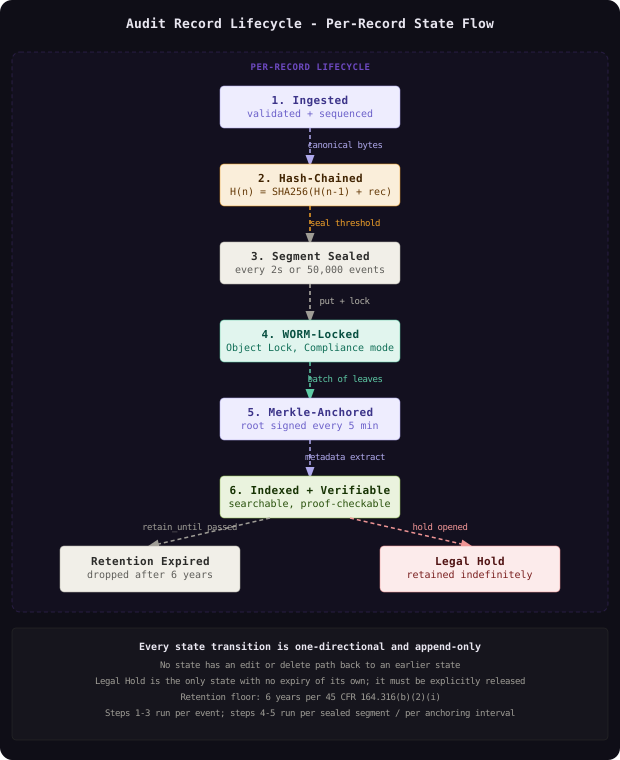
A record moves through six states over its life: ingested, hash-chained, sealed into a segment, WORM-locked, Merkle-anchored, and finally either retention-expired after 6 years or held indefinitely under legal hold. Only the last state has no path back out; every other state moves forward exactly once and never regresses.
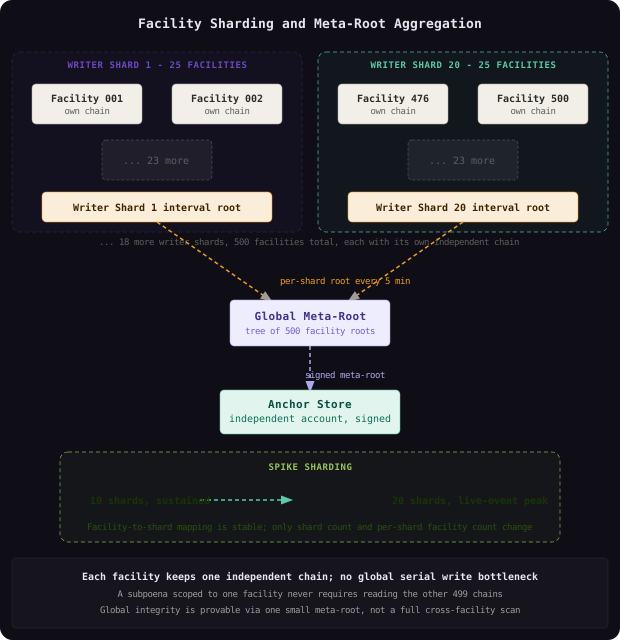
Sharding both the hash chain and the storage layout by facility_id means a subpoena or investigation scoped to one facility never requires touching, exporting, or even reading the other 499 facilities’ chains. Legal isolation falls directly out of the same partitioning decision made for write throughput, rather than needing a separate access-control layer bolted on afterward.
Key Algorithms and Protocols
Canonical Hash Chaining
The chain’s security depends entirely on every party computing the exact same bytes for the exact same logical record, which is a harder problem than it first appears because JSON serialization is not naturally deterministic.
# Canonical encoding edge cases: key order, timestamp precision, unicode normalization
import json
import unicodedata
from datetime import datetime, timezone

def canonicalize_timestamp(ts: str) -> str:
    dt = datetime.fromisoformat(ts.replace("Z", "+00:00")).astimezone(timezone.utc)
    return dt.strftime("%Y-%m-%dT%H:%M:%S.%fZ")[:-3] + "Z"  # millisecond precision, always UTC

def canonicalize_string(value: str) -> str:
    return unicodedata.normalize("NFC", value)  # collapse visually identical unicode sequences

def canonical_record_bytes(record: dict) -> bytes:
    normalized = {
        k: canonicalize_string(v) if isinstance(v, str) else v
        for k, v in sorted(record.items())
    }
    normalized["occurred_at"] = canonicalize_timestamp(record["occurred_at"])
    return json.dumps(normalized, sort_keys=True, separators=(",", ":"), ensure_ascii=True).encode("utf-8")
Time and space are both O(1) per record, independent of chain length, which is exactly why ingestion throughput does not degrade as a facility’s history grows into the billions of records. The edge case worth naming explicitly is unicode normalization: a patient name containing an accented character can be represented by more than one valid unicode byte sequence, and two producers encoding the “same” string differently would silently produce two different chain hashes for what is logically an identical record.
The property that makes hash chaining work at scale is that verification cost is decoupled from chain length for canonicalization and per-record hashing, but proving a single record’s place in history still requires either a full replay or a Merkle proof. Canonicalization alone stops silent re-encoding attacks; it does not solve the O(n) verification problem, which is exactly why Merkle anchoring exists as a separate layer.
Merkle Proof Generation
Generating a proof means walking up from a target leaf to the root, recording the sibling hash needed at each level, which produces a proof of size O(log n) regardless of how many leaves the tree contains.
# Merkle proof generation: sibling collection from leaf to root
# Demonstrates: O(log n) proof size, handling odd leaf counts consistently with build_merkle_root
import hashlib

def merkle_parent(left: bytes, right: bytes) -> bytes:
    return hashlib.sha256(b"\x01" + left + right).digest()

def generate_proof(leaf_hashes: list[bytes], target_index: int) -> list[tuple[bytes, bool]]:
    if not (0 <= target_index < len(leaf_hashes)):
        raise IndexError("target_index out of range")

    proof: list[tuple[bytes, bool]] = []
    level = list(leaf_hashes)
    index = target_index

    while len(level) > 1:
        if len(level) % 2 == 1:
            level.append(level[-1])
        pair_index = index - 1 if index % 2 == 1 else index + 1
        is_sibling_left = index % 2 == 1
        proof.append((level[pair_index], is_sibling_left))
        level = [merkle_parent(level[i], level[i + 1]) for i in range(0, len(level), 2)]
        index //= 2

    return proof
For a batch of 150,000 leaves anchored every five minutes, a proof needs roughly 18 sibling hashes, about 576 bytes, to verify a single record against a 32-byte root. That is the entire reason a 50ms verification target is achievable regardless of how many billions of records a facility’s chain has accumulated over 6 years.
The one property that makes a Merkle proof trustworthy is that recomputing the root from the proof path is deterministic and collision-resistant: forging a proof for a tampered record would require finding a SHA-256 collision at some level of the tree, which is computationally infeasible. The proof’s small size is a convenience; the collision resistance is the actual security guarantee.
Segment Signing and Key Rotation
Signing a segment’s Merkle root, rather than the raw segment bytes, keeps the expensive asymmetric-crypto operation to once per anchoring interval instead of once per record.
# Segment and root signing with key rotation support
# Demonstrates: Ed25519 signing, maintaining a registry of historical public keys
from nacl.signing import SigningKey, VerifyKey
from nacl.exceptions import BadSignatureError

class KeyRegistry:
    """Tracks the currently active signing key plus retired keys still needed
    to verify segments signed before a rotation."""

    def __init__(self):
        self._keys: dict[str, VerifyKey] = {}
        self._active_fingerprint: str | None = None

    def register(self, fingerprint: str, verify_key: VerifyKey, active: bool = False) -> None:
        self._keys[fingerprint] = verify_key
        if active:
            self._active_fingerprint = fingerprint

    def verify(self, fingerprint: str, message: bytes, signature: bytes) -> bool:
        key = self._keys.get(fingerprint)
        if key is None:
            return False
        try:
            key.verify(message, signature)
            return True
        except BadSignatureError:
            return False

def rotate_signing_key(registry: KeyRegistry, new_key: SigningKey, new_fingerprint: str) -> None:
    # Retired keys are never removed from the registry; they remain valid for
    # verifying every segment signed while they were active.
registry.register(new_fingerprint, new_key.verify_key, active=True)The property that makes key rotation safe is that verification always looks up the specific key fingerprint recorded on the segment at signing time, never “whatever key is active now.” Retiring old keys from the registry, rather than keeping them available forever, is the single most common way a rotation silently breaks the ability to verify years-old, still-in-retention segments.
Scaling and Performance
The system scales along two independent axes: the Hash-Chain Log Writer, sharded by facility_id so no single serial chain becomes a write bottleneck, and the Query Index, sharded by month so recent, hot data stays fast to search without every query scanning six years of history.
Capacity Estimation:

Given:
  - 500 facilities, 200,000 staff accounts, 50,000,000 patient records
  - Sustained average: 3,500 events/sec, peak: 20,000 events/sec (shift change + batch sync)
  - Canonical record size: ~400 bytes; chain hash 32 bytes; segment seal every 2s or 50,000 events
  - Retention: 6 years (2,190 days) minimum, extendable under legal hold

Ingestion throughput:
  Sustained: 3,500 events/sec across 500 facilities ~= 7 events/sec/facility average
  Peak: 20,000 events/sec ~= 40 events/sec/facility average, with hot facilities far above that
  Sharding 500 facilities across 20 writer shards (25 facilities/shard):
    Sustained: ~175 events/sec/shard, Peak: ~1,000 events/sec/shard - comfortable headroom per shard

Segment sealing:
  Time-triggered seal every 2s dominates except during sustained peak bursts
  Segments/day: 86,400s / 2s = 43,200 segments/day (per facility upper bound during active hours)
  Merkle anchoring interval: 300s / 2s = ~150 segments aggregated per facility per anchor

Storage:
  Sustained daily volume: 3,500/sec * 86,400s = 302,400,000 events/day
  Raw bytes/day: 302,400,000 * 400 bytes ~= 121 GB/day
  Over 6-year retention (2,190 days): ~121 GB * 2,190 ~= 265 TB of hash-chained records
  Merkle anchors: 500 facilities * 288 intervals/day * (32B root + 64B sig) ~= 13.8 MB/day - trivial

Verification:
  Single-record proof: ~18 sibling hashes for a 150,000-leaf batch ~= 576 bytes, sub-50ms target
  Nightly full chain-replay self-audit: O(n) per facility, run off-peak, parallelized per shard
The read-to-write ratio inverts sharply between the two hot paths: the WORM tier is written constantly and read almost never, except during verification or a full self-audit, while the Query Index is read constantly by auditors and written to only as a metadata extract. We move segments older than 90 days to cheaper cold-tier storage while keeping the same Object Lock retention intact, since access frequency drops off a cliff once a segment is no longer part of a live investigation, but the legal requirement to keep it tamper-evident does not change with age.
Kafka’s per-partition ordering guarantee is the same underlying idea applied to a different problem: strict ordering is only guaranteed within a partition, never globally, which is precisely why partitioning by a natural key (here, facility_id, there, often a customer or device ID) is the standard way to get horizontal write scale without sacrificing the ordering guarantee that actually matters to consumers.
Failure Modes and Recovery
| Failure | Detection | Impact | Recovery |
|---|---|---|---|
| Hash-Chain Log Writer crash mid-segment | Missing seal marker on restart; incomplete segment flagged | Segment left open, potential gap in that facility’s chain | Writer replays from the last durable sequence checkpoint and reseals; unsealed partial data is never discarded, only completed |
| WORM Object Lock misconfigured on a bucket | Nightly automated compliance scan comparing bucket policy against expected Object Lock state | Window of storage that is durable but not actually tamper-proof | Alert fires immediately; lock is reapplied going forward, and the affected window is flagged for manual re-verification against Merkle anchors |
| Clock skew between facilities | Gateway bounds-checks client timestamps against server receive time | Display-order timestamps could look inconsistent across facilities | Server-assigned sequence_no, not client timestamp, is authoritative for ordering; skew is cosmetic, not a chain-integrity issue |
| Query Index falls behind or loses data | Reconciliation job compares index document counts against segment record counts per facility per day | Auditor searches temporarily miss recent records | Index is rebuilt or backfilled directly from WORM segments, since it holds no unique data |
| Hash-chain break detected (possible tampering) | Nightly full chain-replay self-audit, or a Merkle proof verification failure | Potential security incident, chain-of-custody question for the affected range | Freeze the affected facility’s segment range, page security immediately, and use the facility-level sharding to bound the investigation to one chain instead of the whole system |
| Signing key compromise | HSM audit log shows key usage from an unexpected source or at an unexpected volume | Attacker could theoretically forge future signatures until rotation completes | Immediate key rotation; prior segments remain verifiable under the retired key’s registry entry, which is never deleted |
The most common operational mistake is letting the Query Index become a de facto second source of truth simply because auditors find it faster and more pleasant to use than requesting a formal Merkle proof. The moment anyone treats an index document as sufficient evidence on its own, the entire tamper-evidence architecture is providing no actual protection for that specific claim, regardless of how solid the underlying hash chain is.
Comparison of Approaches
| Approach | Latency | Complexity | Failure Mode | Best Fit |
|---|---|---|---|---|
| Plain append-only table, no hash chain | Low, simple inserts | Low | Deletion or in-place alteration is completely undetectable | Low-stakes internal logging where legal defensibility is not required |
| Hash chain only, no Merkle anchor, no WORM lock | Low ingestion latency | Medium | Tampering is detectable only via a full O(n) replay, and unlocked storage means the underlying files can simply be deleted, bypassing the chain entirely | Small-scale audit needs where the storage layer is otherwise fully trusted |
| Fully decentralized blockchain / distributed ledger | High, consensus overhead dominates | Very high | Throughput ceiling for most permissioned chains sits well below sustained requirements; operational burden is large for the integrity gained | Regulatory or contractual requirements that specifically mandate external, decentralized custody |
| Managed ledger database (for example, a QLDB-style service) | Moderate, managed infrastructure | Low, vendor-operated | Vendor lock-in; limited control over sharding strategy, region placement, and cost at very large scale | Organizations that would rather buy than build and operate at moderate scale |
| Hash chain + Merkle anchoring + WORM storage (this design) | Low ingestion latency; fast proof-based verification | High, multiple coordinated components and key management | Requires disciplined HSM and key-rotation operations, but blast radius is bounded per facility and every claim is independently provable | HIPAA-covered entities operating at hundreds of facilities and multi-year retention requirements |
For a healthcare network at 500 facilities and a hard 6-year regulatory retention floor, the hash chain plus Merkle anchoring plus WORM design is the right call: it is the only option here that combines low-latency ingestion with a verification story that does not depend on trusting the organization being audited, and it scales cleanly with facility-based sharding rather than hitting a consensus-driven throughput ceiling. A managed ledger service is a reasonable substitute for a smaller organization willing to trade some architectural control for operational simplicity, but at this scale the cost and flexibility tradeoffs favor owning the design directly.
Key Takeaways
- Separate the log from the index: the tamper-evident log is the system of record; the query index is disposable and rebuildable, and conflating the two quietly destroys the entire integrity guarantee.
- Hash chaining turns silent deletion into detectable breakage: every record’s hash depends on the one before it, so altering or removing any past entry breaks every subsequent hash.
- Merkle anchoring makes verification cheap regardless of history size: a proof of roughly 18 hashes can verify one record out of 150,000 without replaying anything.
- WORM Compliance mode is a structural guarantee, not a policy one: unlike IAM permissions, it cannot be bypassed by anyone, including the account root, until the retention date passes.
- Canonicalization is a prerequisite for hash chaining, not an implementation detail: nondeterministic serialization silently breaks the chain’s core assumption that identical records produce identical hashes.
- Shard by facility, not by time or by request volume alone: it simultaneously solves the write-throughput bottleneck and gives legal investigations a natural, pre-existing isolation boundary.
- Retention and legal hold are separate controls: a fixed 6-year floor and an indefinite, explicitly-opened hold serve different purposes and should never be conflated into a single retention field.
- Fail loud, never silent: a dropped, malformed, or unsequenced audit event is a worse outcome than a rejected write the source system can retry.
The counter-intuitive lesson is that the hardest part of this system is not the cryptography, it is resisting the temptation to let the fast, pleasant-to-query index quietly become the thing everyone actually trusts. The math behind hash chains and Merkle proofs is well understood and has existed for decades; what breaks tamper-evident systems in practice is an operational shortcut, someone treating a rebuildable convenience layer as if it carried the same evidentiary weight as the WORM-locked, cryptographically chained original.
Frequently Asked Questions
Q: Why not just use a blockchain or fully decentralized ledger instead of a hash chain plus WORM storage?
A: A permissioned or public blockchain adds consensus overhead that most implementations cannot sustain at 20,000 events/sec, and the decentralization it provides solves a trust problem this system does not actually have, since a single covered entity already controls its own infrastructure and simply needs to prove it has not altered its own records. The hash chain plus Merkle anchoring plus independently secured WORM storage gives the same tamper-evidence property at a fraction of the operational cost and complexity.
Q: Why not rely on strict IAM permissions instead of paying for WORM Object Lock?
A: IAM policies are mutable by design, which means an IAM-only guarantee reduces to “nobody has changed the policy yet,” not a structural impossibility. Object Lock Compliance mode is fundamentally different: once set, the retention date cannot be shortened or bypassed by any principal, including the account root, which is the actual guarantee a HIPAA audit trail needs to survive an insider threat or a compromised operations account.
Q: Why not make the Elasticsearch or OpenSearch index the source of truth to simplify the architecture?
A: Search indexes are explicitly designed to be mutable and easy to update, which is precisely the opposite of what a tamper-evident log requires. Treating the index as authoritative means an attacker who compromises only the indexing pipeline, without ever touching the WORM tier, could rewrite what auditors see with no cryptographic trace at all, defeating the entire premise of the system.
Q: How do you handle a legitimate correction, like an audit event mistakenly linked to the wrong patient?
A: The original event is never edited or deleted; a new corrective event is appended that references the original event’s ID and states the correction, exactly like the ink-and-strikethrough convention on a paper chart. The full history, including the mistake and its correction, remains visible and verifiable, which is itself often more useful during an investigation than a record that looks like it was always correct.
Q: What happens to segments signed under an old key once that key is rotated out?
A: Retired public keys are never removed from the key registry; each segment’s signature is verified against the specific key fingerprint recorded at signing time, not against whatever key happens to be active when verification runs. Rotation adds a new active key going forward and never invalidates a properly retained historical key.
Q: Doesn’t encrypting the audit log already provide tamper evidence, since an attacker without the key cannot read or meaningfully edit it?
A: Encryption protects confidentiality, not integrity. An attacker does not need to understand a ciphertext blob’s contents to replace it with a different ciphertext blob, or to delete it outright, and standard encryption gives no signal that either happened. Hash chaining and signing detect exactly those two attacks; encryption is a complementary, separate control for a different threat.
Interview Questions
Q: Design the ingestion path so that an audit write never blocks or slows down the clinical transaction that triggered it, while still guaranteeing the event is never silently lost. What tradeoffs would you make?
Expected depth: Discuss asynchronous, at-least-once delivery from the clinical system to the ingestion gateway, idempotency keys to absorb retries safely, and why the system must fail loud (reject and retry) rather than fail silent (accept and drop) when it cannot durably sequence an event. Cover the tradeoff between synchronous acknowledgment latency and the risk of accepting a write the downstream hash-chain writer later cannot durably process.
Q: How would you detect that a single record was deleted from a chain of 300 million events spanning 6 years, without replaying the entire chain?
Expected depth: Explain Merkle tree construction over periodic batches, proof generation of O(log n) size, and why proof verification depends on SHA-256 collision resistance rather than trusting any party’s claim. Cover what a periodic full chain-replay self-audit adds beyond spot-checking individual records with proofs.
Q: How do you scale write throughput across 500 facilities without a single serialized hash chain becoming the bottleneck, while still being able to prove the integrity of the system as a whole?
Expected depth: Discuss sharding independent hash chains by facility_id, why a single global chain would serialize all writes through one bottleneck, and how a global meta-root aggregating each facility’s interval root preserves a system-wide integrity claim without forcing a single serialization point for writes.
Q: Walk through what happens end to end when the Ed25519 signing key used for Merkle roots is suspected to be compromised.
Expected depth: Cover immediate key rotation, why historical segments remain verifiable through a retained key registry keyed by signature fingerprint rather than “whichever key is currently active,” and the operational discipline (HSM-backed keys, audit logging of key usage) needed to detect compromise in the first place.
Q: An auditor needs to find every access to a specific patient’s record across 6 years of history within 2 seconds. How would you build that search capability without letting it become the system’s actual trust boundary?
Expected depth: Discuss the disposable metadata index sharded by month, why it must be rebuildable purely from WORM segments, and how a search result is only a starting point for an auditor, who then requests a formal Merkle proof against the underlying chain before treating any specific record as verified for legal or compliance purposes.
Premium Content
Unlock the full article along with everything else in the archive — all in one place.