The UUID That Wasn't Random
security api-design databases
System Design Scenario
The UUID That Wasn’t Random
When predictable IDs become a competitive intelligence leak
Thursday, 10:30 AM. The compliance team walks into the engineering room with printed web pages. “Did you know that CompetitorX has been scraping our entire customer database?” The pages show screenshots of their internal customer management system - customer names, order values, signup dates, pricing tiers. All scraped systematically from public URLs.
The vulnerability was hiding in plain sight: https://app.company.com/orders/147823. Sequential integer IDs in every URL. A competitor wrote a simple script that started at /orders/1 and incremented upward, pulling every order in the database. Over six months, they downloaded 150,000 customer records, complete business metrics, and competitive intelligence that would cost millions in market research.
The security audit revealed the scope: user profiles at /users/12345, invoices at /invoices/67890, support tickets at /tickets/54321. Every resource in the system was enumerable. Every business metric was public. A five-line Python script with a for loop had turned the entire application into an open book.
This is an IDOR (Insecure Direct Object Reference) vulnerability. When your resource identifiers are predictable, authorization becomes meaningless. Anyone who can guess the next ID can access resources they shouldn’t see.
Why This Happens
The instinct is to use auto-incrementing primary keys from the database as public identifiers. It’s simple, predictable, and works perfectly in internal systems where you control all access. Most developers learn SQL with id INTEGER PRIMARY KEY AUTO_INCREMENT - it’s the default pattern in every tutorial.
But databases and public APIs have different security models. Database primary keys are designed for efficiency and referential integrity. Public identifiers need to be opaque and unpredictable. When you expose internal database structure directly to users, you’re assuming that your authorization layer will perfectly catch every access control bug.
The vulnerability chain looks like this:
sequential ID exposed in URL
  -> attacker discovers pattern
    -> automated enumeration begins
      -> authorization checks bypassed or missing
        -> data exfiltration at scale
          -> business intelligence leak
            -> competitive damage
The problem compounds because authorization bugs are common and hard to test exhaustively. You might perfectly secure access to individual resources, but miss edge cases around resource enumeration, pagination limits, or batch operations.
Predictable resource identifiers turn authorization bugs from targeted exploits into systematic data harvesting - a single missed permission check becomes a database-wide vulnerability.
The Naive Solution (and where it breaks)
Most teams first try to fix this by adding more authorization checks. If the problem is that attackers can guess IDs, the thinking goes, just make sure every ID access is properly authorized. Add permission checks, validate ownership, require authentication tokens.
This approach is like putting stronger locks on doors while leaving the house numbers sequential. You’ve made individual break-ins harder but haven’t addressed the enumeration problem.
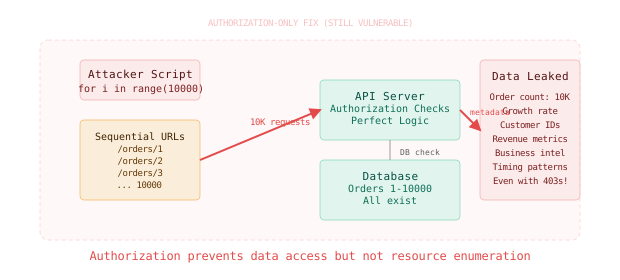
The problems with authorization-only fixes:
First, authorization complexity. Every endpoint needs perfect permission logic. User 12345 can see their own orders, but not orders 12344 or 12346 unless they’re an admin, unless it’s a shared order, unless they’re in the same organization, unless it’s a public order type. The authorization matrix becomes unmaintainable.
Second, testing gaps. It’s impossible to test every combination of user permissions and resource access patterns. Your tests might verify that user A can’t access user B’s order, but miss that user A can enumerate all order IDs to discover which orders exist, when they were created, and infer business metrics from the gaps.
Third, performance impact. Every resource access requires database queries to validate ownership. Loading a page with 20 order references now requires 20 additional authorization queries. The security fix becomes a performance bottleneck.
Small scale: 10 resources, 2 user roles -> authorization works
Large scale: 1M resources, 20 user roles, complex permissions -> authorization breaks or slows system
Authorization-only approaches also fail during edge cases: background jobs, admin panels, data exports, third-party integrations. Each context needs its own permission model, and any gap in coverage reopens the enumeration vulnerability.
Perfect authorization is impossible to achieve and expensive to maintain - unpredictable identifiers provide defense in depth by making enumeration attacks impractical regardless of authorization bugs.
The Better Solution
Here’s what actually fixes this: unpredictable resource identifiers that can’t be enumerated. Think of it like house addresses on a street with no pattern - even if you know one address, you can’t guess the others.
UUID Version 4 for Public Identifiers
Replace sequential integers with cryptographically random UUIDs for any identifier that appears in public-facing interfaces.
-- Before: predictable integer IDs
CREATE TABLE orders (
  id INTEGER PRIMARY KEY AUTO_INCREMENT,
  user_id INTEGER,
  amount DECIMAL(10,2),
  created_at TIMESTAMP
);
-- URLs: /orders/1, /orders/2, /orders/3 (easily enumerable)

-- After: UUIDs for public exposure
CREATE TABLE orders (
  id INTEGER PRIMARY KEY AUTO_INCREMENT,  -- Keep for joins/performance
  public_id UUID DEFAULT (UUID()) UNIQUE NOT NULL,  -- Expose this
  user_id INTEGER,
  amount DECIMAL(10,2),
  created_at TIMESTAMP,
  INDEX idx_public_id (public_id)
);
-- URLs: /orders/f47ac10b-58cc-4372-a567-0e02b2c3d479 (not enumerable)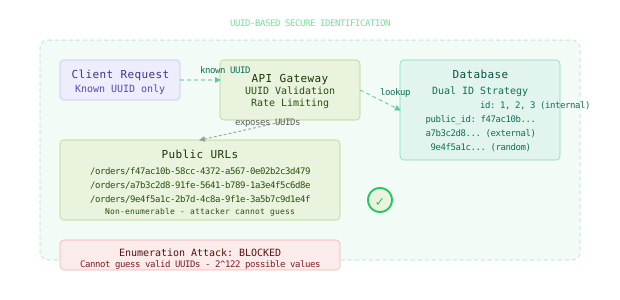
The UUID approach maintains internal database efficiency while preventing external enumeration. Your application uses UUIDs in all public interfaces but still uses integer IDs for database joins and internal operations.
GitHub uses this exact pattern - repository IDs are sequential integers internally for database efficiency, but all public URLs use unpredictable tokens like /repos/octocat/Hello-World/issues/1347 where the repository name acts as a non-enumerable identifier.
ULID for Time-Ordered Non-Enumerable IDs
When you need time-ordering capabilities with enumeration protection, ULIDs (Universally Unique Lexicographically Sortable Identifiers) provide both benefits.
# ULID implementation for time-ordered secure IDs
import ulid
import time
from datetime import datetime

class SecureIDGenerator:
    def __init__(self):
        self.ulid_gen = ulid.ULID()

    def generate_id(self, timestamp=None):
        """Generate a ULID with optional custom timestamp"""
        if timestamp is None:
            timestamp = time.time()
        return str(self.ulid_gen.generate(timestamp))

    def parse_timestamp(self, ulid_str):
        """Extract timestamp from ULID for time-based queries"""
        ulid_obj = ulid.parse(ulid_str)
        return datetime.fromtimestamp(ulid_obj.timestamp / 1000)

# Usage in application
id_gen = SecureIDGenerator()

# Generate ULID for new order
order_id = id_gen.generate_id()  # "01ARZ3NDEKTSV4RRFFQ69G5FAV"

# ULIDs are sortable by creation time
order_ids = [
    id_gen.generate_id(),
    id_gen.generate_id(),
    id_gen.generate_id()
]
sorted_ids = sorted(order_ids)  # Chronologically ordered

# Extract timestamp for time-based queries
creation_time = id_gen.parse_timestamp(order_ids[0])
print(f"Order created at: {creation_time}")
Object-Level Authorization with Non-Enumerable IDs
Combine unpredictable identifiers with explicit object-level permissions to create defense in depth.
# Authorization framework with secure IDs
from typing import Optional
import uuid
from enum import Enum

class Permission(Enum):
    READ = "read"
    WRITE = "write"
    DELETE = "delete"
    ADMIN = "admin"

class ResourceAuthorizer:
    def __init__(self, db_connection):
        self.db = db_connection

    def check_access(self, user_id: int, resource_public_id: str,
                    permission: Permission) -> bool:
        """
        Check if user has permission for resource
        Uses public_id to prevent enumeration attacks
        """
        # First verify resource exists and get internal ID
        resource = self.db.execute(
            "SELECT id, owner_id, permissions FROM orders WHERE public_id = %s",
            (resource_public_id,)
        ).fetchone()

        if not resource:
            return False  # Resource doesn't exist

        resource_id, owner_id, permissions = resource

        # Owner has all permissions
        if user_id == owner_id:
            return True

        # Check explicit permissions table
        granted = self.db.execute(
            """SELECT permission FROM resource_permissions
               WHERE resource_id = %s AND user_id = %s AND permission = %s""",
            (resource_id, user_id, permission.value)
        ).fetchone()

        return granted is not None

    def get_user_resources(self, user_id: int, permission: Permission):
        """Get resources user has access to - no enumeration possible"""
        resources = self.db.execute(
            """SELECT o.public_id, o.created_at, o.amount
               FROM orders o
               LEFT JOIN resource_permissions rp ON o.id = rp.resource_id
               WHERE o.owner_id = %s
                  OR (rp.user_id = %s AND rp.permission = %s)
               ORDER BY o.created_at DESC""",
            (user_id, user_id, permission.value)
        ).fetchall()

        return resources

# API endpoint with secure authorization
from flask import Flask, request, jsonify
app = Flask(__name__)

@app.route('/orders/<order_public_id>')
def get_order(order_public_id):
    # Validate UUID format to prevent injection
    try:
        uuid.UUID(order_public_id)  # Raises ValueError if invalid
    except ValueError:
        return jsonify({"error": "Invalid order ID format"}), 400

    user_id = get_current_user_id()  # From authentication
    authorizer = ResourceAuthorizer(get_db_connection())

    # Check authorization using non-enumerable ID
    if not authorizer.check_access(user_id, order_public_id, Permission.READ):
        return jsonify({"error": "Order not found"}), 404  # Same response for not found vs unauthorized

    # Fetch order data using public ID
    order = get_order_by_public_id(order_public_id)
return jsonify(order)The key mechanism is making resource discovery require authorization - unpredictable IDs ensure that knowing about a resource requires having permission to access it or being explicitly granted the identifier.
The Full Architecture
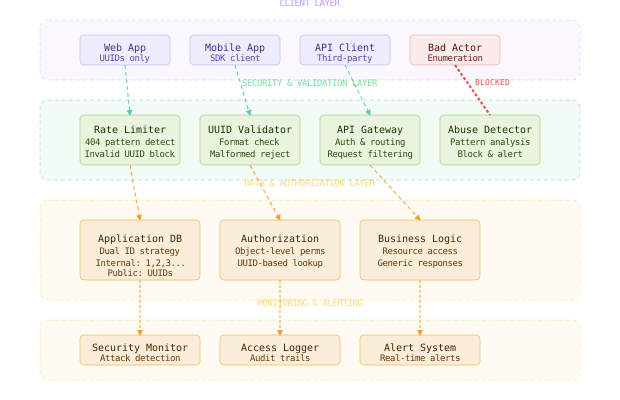
The complete architecture uses multiple layers of protection. The database maintains efficient integer primary keys for internal operations while exposing only unpredictable UUIDs or ULIDs in public interfaces. Object-level authorization provides explicit permission checking. Rate limiting prevents automated enumeration attempts. Monitoring detects suspicious access patterns.
When a user requests a resource, the system validates the UUID format, checks object-level permissions, and returns either the resource data or a generic “not found” response. Failed authorization attempts are logged and monitored for abuse patterns. The architecture makes it computationally infeasible to discover resources through enumeration while maintaining performance for legitimate access patterns.
The most important design decision is treating resource identifiers as secrets - any ID that appears in a public interface should be treated with the same security consideration as an authentication token.
Component Deep Dives
Dual ID Strategy Implementation
Maintain internal efficiency while preventing external enumeration by using both internal integers and external UUIDs.
-- Database schema with dual ID approach
CREATE TABLE orders (
  -- Internal ID for joins, foreign keys, and performance
  id BIGINT PRIMARY KEY AUTO_INCREMENT,

  -- External ID for public APIs (never expose internal ID)
  public_id CHAR(36) NOT NULL UNIQUE DEFAULT (UUID()),

  -- Business data
  user_id BIGINT NOT NULL,
  product_id BIGINT NOT NULL,
  amount DECIMAL(10,2) NOT NULL,
  status ENUM('pending', 'completed', 'cancelled') NOT NULL,
  created_at TIMESTAMP DEFAULT CURRENT_TIMESTAMP,
  updated_at TIMESTAMP DEFAULT CURRENT_TIMESTAMP ON UPDATE CURRENT_TIMESTAMP,

  -- Indexes for performance
  INDEX idx_public_id (public_id),
  INDEX idx_user_orders (user_id, created_at),
  INDEX idx_status (status),

  FOREIGN KEY (user_id) REFERENCES users(id),
  FOREIGN KEY (product_id) REFERENCES products(id)
);

-- Application layer functions
DELIMITER $$
CREATE FUNCTION get_internal_id_from_public(public_uuid CHAR(36))
RETURNS BIGINT
READS SQL DATA
DETERMINISTIC
BEGIN
    DECLARE internal_id BIGINT;
    SELECT id INTO internal_id FROM orders WHERE public_id = public_uuid;
    RETURN internal_id;
END$$
DELIMITER ;
Rate Limiting for Enumeration Protection
Implement rate limiting specifically designed to prevent systematic enumeration attacks.
# Rate limiter designed for enumeration protection
from collections import defaultdict
import time
import redis
from typing import Dict, List

class EnumerationProtector:
    def __init__(self, redis_client):
        self.redis = redis_client
        self.windows = {
            '404_responses': {'limit': 10, 'window': 300},    # 10 not-found in 5 minutes
            'invalid_uuid': {'limit': 5, 'window': 60},       # 5 invalid UUIDs in 1 minute
            'rapid_sequential': {'limit': 50, 'window': 60},  # 50 requests in 1 minute
        }

    def check_enumeration_attempt(self, client_id: str, request_type: str) -> bool:
        """Returns True if request should be allowed, False if blocked"""

        if request_type not in self.windows:
            return True

        config = self.windows[request_type]
        key = f"enum_protect:{request_type}:{client_id}"

        current_time = int(time.time())
        window_start = current_time - config['window']

        # Clean old entries and count current requests
        pipe = self.redis.pipeline()
        pipe.zremrangebyscore(key, 0, window_start)
        pipe.zadd(key, {current_time: current_time})
        pipe.zcard(key)
        pipe.expire(key, config['window'])

        results = pipe.execute()
        current_count = results[2]

        return current_count <= config['limit']

    def record_suspicious_pattern(self, client_id: str, pattern_type: str,
                                 details: Dict):
        """Log suspicious enumeration patterns for analysis"""
        log_entry = {
            'timestamp': time.time(),
            'client_id': client_id,
            'pattern_type': pattern_type,
            'details': details
        }

        # Store in Redis for real-time analysis
        self.redis.lpush('enumeration_attempts', json.dumps(log_entry))
        self.redis.ltrim('enumeration_attempts', 0, 10000)  # Keep last 10k attempts

        # Trigger alert if pattern matches known attack signatures
        if self.is_attack_signature(pattern_type, details):
            self.trigger_security_alert(client_id, log_entry)

# Integration with API endpoint
@app.route('/orders/<order_public_id>')
def get_order(order_public_id):
    client_id = get_client_identifier(request)  # IP + User-Agent hash
    protector = EnumerationProtector(get_redis_connection())

    # Check UUID format
    try:
        uuid.UUID(order_public_id)
    except ValueError:
        if not protector.check_enumeration_attempt(client_id, 'invalid_uuid'):
            return jsonify({"error": "Rate limited"}), 429
        return jsonify({"error": "Invalid order ID format"}), 400

    # Check general rate limits
    if not protector.check_enumeration_attempt(client_id, 'rapid_sequential'):
        protector.record_suspicious_pattern(client_id, 'rapid_fire', {
            'endpoint': '/orders/<id>',
            'attempted_id': order_public_id
        })
        return jsonify({"error": "Rate limited"}), 429

    # Get order
    order = get_order_by_public_id(order_public_id)
    if not order:
        if not protector.check_enumeration_attempt(client_id, '404_responses'):
            protector.record_suspicious_pattern(client_id, 'enumeration_sweep', {
                'endpoint': '/orders/<id>',
                'consecutive_404s': True
            })
            return jsonify({"error": "Rate limited"}), 429
        return jsonify({"error": "Order not found"}), 404

    return jsonify(order)
UUID Performance Optimization
Optimize database performance when using UUIDs as lookup keys.
-- Optimized UUID storage and indexing
-- Use BINARY(16) instead of CHAR(36) for storage efficiency
ALTER TABLE orders
  MODIFY COLUMN public_id BINARY(16) NOT NULL,
  DROP INDEX idx_public_id,
  ADD INDEX idx_public_id_binary (public_id);

-- Application helper functions for UUID conversion
import uuid
def uuid_to_binary(uuid_str: str) -> bytes:
"""Convert UUID string to binary for efficient storage"""
return uuid.UUID(uuid_str).bytes
def binary_to_uuid(uuid_bytes: bytes) -> str:
"""Convert binary UUID back to string"""
return str(uuid.UUID(bytes=uuid_bytes))
def get_order_by_public_id(public_id_str: str):
"""Optimized order lookup using binary UUID"""
binary_id = uuid_to_binary(public_id_str)
result = db.execute(
"SELECT id, user_id, amount, status, created_at FROM orders WHERE public_id = %s",
(binary_id,)
).fetchone()
if result:
return {
'id': public_id_str, # Return string UUID to client
'user_id': result[1],
'amount': str(result[2]),
'status': result[3],
'created_at': result[4].isoformat()
}
return NoneThe binary UUID approach reduces storage by 60% (16 bytes vs 36 characters) and improves index performance while maintaining the security benefits of unpredictable identifiers.
Comparison Table
| Approach | Storage Efficiency | Enumeration Risk | Performance | Implementation Complexity | Authorization Burden | Best Use Case |
|---|---|---|---|---|---|---|
| Sequential integers | Excellent | Critical | Excellent | Very Low | Very High | Internal tools only |
| UUIDs in URLs | Good | None | Good | Low | Low | Most public APIs |
| ULIDs | Good | None | Good | Medium | Low | Time-ordered public resources |
| Encrypted IDs | Excellent | None | Good | High | Low | High-security applications |
| JWT tokens as IDs | Poor | None | Poor | Very High | None | Temporary resource access |
| Hash-based IDs | Good | Very Low | Good | Medium | Medium | Legacy system migration |
For most applications, UUIDs provide the best balance of security, performance, and implementation simplicity. ULIDs add time-ordering benefits when needed. Reserve more complex approaches for applications with specific security or performance requirements.
Key Takeaways
- Sequential IDs in public interfaces create systematic enumeration vulnerabilities that turn single authorization bugs into database-wide breaches
- Unpredictable identifiers provide defense in depth by making resource discovery require authorization regardless of other security bugs
- Dual ID strategies maintain database performance with internal integers while exposing only unpredictable IDs in public APIs
- UUID v4 provides cryptographically random identifiers that are computationally infeasible to enumerate
- ULIDs combine unpredictability with time-ordering when chronological sorting is required
- Rate limiting should specifically target enumeration patterns: rapid 404 responses, invalid ID formats, and sequential access attempts
- Authorization consistency matters less when resource discovery itself requires permission - attackers can’t exploit what they can’t find
- Performance optimization for UUIDs requires binary storage and proper indexing strategies
The hardest lesson about resource identification is that convenience and security often oppose each other. Sequential IDs feel natural because they’re how humans think about ordering, but they leak information about your business operations to anyone who can increment a number.
Frequently Asked Questions
Q: How do UUIDs impact database performance compared to integer IDs? A: UUIDs are larger (16 bytes vs 8 bytes for BIGINT) and less cache-friendly for joins. Use binary storage format, maintain integer PKs for internal joins, and only expose UUIDs in public interfaces. Performance impact is typically less than 10% for most applications when properly optimized.
Q: What if I need to migrate existing sequential IDs to UUIDs without breaking compatibility? A: Add a UUID column alongside existing integer IDs, populate UUIDs for all existing records, update application code to use UUIDs in new public interfaces, and gradually migrate existing endpoints. Maintain both ID types during transition period with feature flags.
Q: Can encrypted sequential IDs provide the same protection as UUIDs? A: Encrypted IDs can work but add complexity: key management, encryption/decryption overhead, and key rotation requirements. They’re also vulnerable if the encryption key is compromised. UUIDs are simpler and don’t require cryptographic key management.
Q: How do you handle UUID collisions in high-throughput systems? A: UUID v4 collision probability is negligible (1 in 2^122). For extreme throughput, consider ULIDs which include timestamp components to reduce collision probability further, or use database-generated UUIDs with collision detection and retry logic.
Q: Should internal microservice APIs use UUIDs if they’re not public-facing? A: If internal APIs are only accessible within your secure network and proper network segmentation exists, sequential IDs may be acceptable. However, using UUIDs consistently reduces complexity and provides defense against insider threats or network compromise.
Q: How do you implement pagination with non-sequential UUIDs? A: Use cursor-based pagination with created_at timestamps plus UUIDs for tie-breaking, or implement offset-based pagination with performance warnings for large offsets. Avoid exposing total counts which can leak business metrics.
Interview Questions
Q: Design a secure resource identification system for a multi-tenant SaaS application with 1 million users. Expected depth: Discuss tenant isolation, UUID generation strategies, database partitioning considerations, performance optimization for UUID lookups, and rate limiting for enumeration protection. Address cross-tenant access prevention and monitoring for suspicious access patterns.
Q: How would you migrate a legacy system from sequential IDs to secure identifiers with zero downtime? Expected depth: Plan dual-write strategy, gradual endpoint migration, database schema changes, application code updates, and rollback procedures. Discuss testing strategies, performance monitoring during transition, and handling existing external integrations that depend on sequential IDs.
Q: A security researcher reports they can enumerate your entire user database through profile URLs. How do you respond? Expected depth: Immediate response procedures, impact assessment, communication with stakeholders, hotfix deployment strategy, and long-term remediation. Address incident response, customer notification requirements, and prevention of similar vulnerabilities across other endpoints.
Q: Design IDOR protection for an API that needs to support both public and private resources. Expected depth: Discuss resource visibility models, hybrid identification schemes, caching strategies for authorization, and API design patterns that minimize enumeration risk. Address performance implications of authorization checks and monitoring for abuse patterns.
Q: How would you implement secure resource sharing where users can grant temporary access to specific resources? Expected depth: Plan time-limited access tokens, resource-specific permissions, delegation models, and audit trails. Discuss token generation, validation, revocation, and preventing token-based enumeration attacks while maintaining usability for legitimate sharing.
Want to see how these patterns hold up when traffic spikes 50x at 3 AM? That's exactly what this Premium deep-dive covers.