The Hotfix That Needed Another Hotfix
devops deployment reliability
System Design Scenario
The Hotfix That Needed Another Hotfix
When urgent production fixes cascade into a chain reaction of breakage and panic
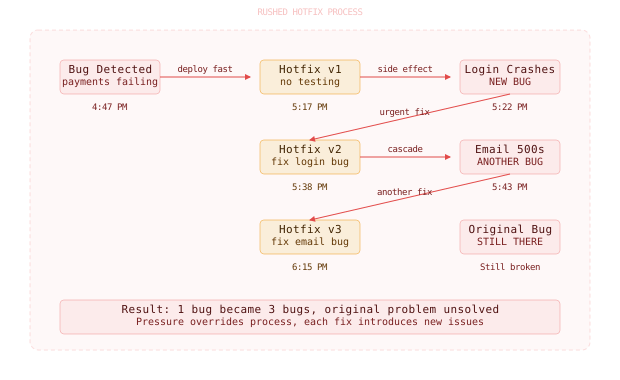
It’s Friday at 4:47 PM when the alerts start firing. Payment processing is failing for 15% of transactions. Revenue is hemorrhaging at $2,000 per minute. The team deploys a hotfix within 30 minutes - a one-line change that looks bulletproof. Five minutes later, the login system crashes. Users can’t sign in at all now.
The hotfix hotfix goes out at 5:38 PM. Login works, but now the email service is throwing 500 errors. Welcome emails, password resets, and notifications all broken. It’s like trying to fix a burst pipe by turning off the main water supply, only to discover you’ve shut off water to the entire building. By 6:15 PM, there are three critical systems down and the original payment bug is still there, hiding behind two layers of emergency fixes.
This is the hotfix cascade - a single production issue that multiplies into multiple production issues through hasty emergency responses. Each fix introduces new failure modes, and each new failure demands another urgent fix. The original problem becomes three problems, and Friday evening becomes Saturday morning.
Why This Happens
The instinct during production incidents is to find the fastest possible fix and deploy it immediately. Time pressure overwhelms normal engineering judgment. When systems are failing and revenue is at risk, thorough testing feels like a luxury you can’t afford.
Hotfixes fail because they bypass the safety mechanisms that prevent bugs in the first place. No code review means no second pair of eyes. No staging deployment means no integration testing. No canary release means no gradual rollout. The very speed that makes hotfixes effective also makes them dangerous.
Production incident detected
  -> Pressure to fix immediately
    -> Skip normal safety checks
      -> Deploy untested code
        -> New bug introduced
          -> Cascade begins
The deeper issue is architectural coupling. Systems that work fine independently break when one component changes unexpectedly. The payment hotfix modified a shared error handling library. Login used that library. Email service used login for API authentication. One change rippled through three systems.
Hotfixes fail not because the code is wrong, but because the deployment process skips integration testing.
The Naive Solution (and where it breaks)
Most teams reach for better code review on hotfixes or dedicated “war room” processes with more people involved. The thinking is that additional scrutiny will catch bugs before they reach production.
Better code review on hotfixes is like having firefighters conduct safety inspections while the building is burning. The time pressure overwhelms the review quality. Reviewers feel compelled to approve quickly to resolve the incident, and they focus on whether the fix addresses the immediate issue, not whether it introduces new problems elsewhere.
War room processes suffer from groupthink under pressure. More people doesn’t guarantee better decisions when everyone is focused on speed over safety. The group can collectively overlook integration risks that would be obvious during normal development.
Adding people to hotfix decisions often amplifies pressure and reduces critical thinking quality.
Small scale: 2-person review -> catches obvious bugs
Large scale: 6-person war room -> group pressure overrides individual concerns
The Better Solution - Feature Flags
Here’s what actually fixes this: use feature flags to isolate changes and enable instant rollback without deployment. Feature flags are like electrical circuit breakers - they allow you to cut power to a specific feature without taking down the entire system.
When a production issue occurs, the solution isn’t to deploy a code fix. The solution is to disable the problematic feature, assess the situation properly, then deploy a tested fix behind a flag before re-enabling.
# Feature flag configuration
payment_processing_v2:
  enabled: false  # Instant rollback
  rollout_percentage: 0
  user_segments: []

enhanced_error_handling:
  enabled: true
  rollout_percentage: 25  # Gradual rollout
  user_segments: ["beta_users"]
Feature flags decouple deployments from releases. You can deploy the fix to production with the flag disabled, test it in production with internal traffic, then gradually enable it for real users.
Facebook’s approach to incidents: disable the feature first, fix it second. Their feature flag system can disable any feature in under 30 seconds globally.
The Better Solution - Staged Rollouts
Even with feature flags, you need staged rollouts to prevent hotfix cascades. Deploy fixes to production gradually: internal users first, then 1% of traffic, then 5%, then 25%, then everyone.
# Staged rollout configuration
class RolloutConfig:
    def __init__(self):
        self.stages = [
            {"name": "internal", "percentage": 0, "users": ["employee"]},
            {"name": "canary", "percentage": 1, "duration_hours": 2},
            {"name": "pilot", "percentage": 5, "duration_hours": 4},
            {"name": "production", "percentage": 100, "duration_hours": 0}
        ]

    def should_enable_for_user(self, user_id, feature_flag):
        current_stage = self.get_current_stage(feature_flag)

        if current_stage["name"] == "internal":
            return user_id in self.get_internal_users()

        return hash(user_id) % 100 < current_stage["percentage"]
Each stage has automatic monitoring and rollback triggers. If error rates spike above baseline during any stage, the rollout automatically reverts to the previous stage.
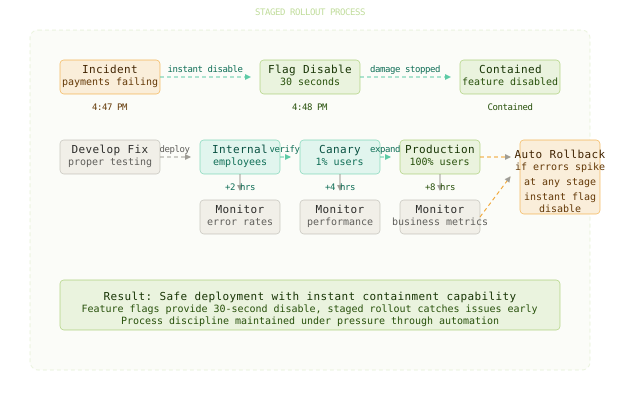
The key insight is that production issues don’t require production-speed fixes. They require production-quality fixes deployed safely. Feature flags give you the speed (instant disable), and staged rollouts give you the safety (gradual validation).
The Better Solution - Comprehensive Incident Response
For complex incidents, implement a structured response process that prioritizes containment over resolution. Stop the bleeding first, then fix the wound properly.
# Incident response automation
class IncidentManager:
    def __init__(self):
        self.stages = ["detect", "contain", "investigate", "fix", "verify", "close"]
        self.current_stage = "detect"

    def handle_incident(self, incident):
        if self.current_stage == "detect":
            self.create_incident_room(incident)
            self.page_on_call_engineer()
            self.current_stage = "contain"

        elif self.current_stage == "contain":
            # First priority: stop the damage
            self.disable_affected_features(incident.affected_systems)
            self.scale_up_healthy_systems()
            self.current_stage = "investigate"

        elif self.current_stage == "investigate":
            # Don't rush to fix - understand first
            self.collect_logs(incident.timeframe)
            self.analyze_blast_radius(incident.affected_systems)
            self.identify_root_cause()
self.current_stage = "fix"Incident containment (feature flags, traffic routing) is faster and safer than incident resolution (code fixes).
The Full Architecture

The complete system has five layers working together. The monitoring layer detects issues and triggers automated responses. The feature flag service can instantly disable problematic features. The deployment pipeline enforces staged rollouts with automatic rollback triggers. The incident management system coordinates human response and tracks progress. The communication system keeps stakeholders informed without adding operational overhead.
When an incident occurs, the system first disables the problematic feature through flags, containing the damage within seconds. The incident manager coordinates investigation while engineers prepare a proper fix. The fix gets deployed through the normal staged pipeline, but behind a feature flag so it can be enabled gradually and rolled back instantly if needed.
This architecture recognizes that production incidents are not code problems - they are process problems. The code bug is secondary to the deployment process that let the bug reach production and the response process that either contains or amplifies the damage.
The fastest incident response is prevention through feature flags, not speed through bypassed process.
Component Deep Dives
Feature Flag Service
The feature flag service’s job is to make real-time feature availability decisions across all systems. It needs to be faster and more reliable than the systems it controls.
// High-performance feature flag evaluation
type FeatureFlagService struct {
    cache    *redis.Client
    fallback map[string]bool  // Local fallback for Redis failures
}

func (f *FeatureFlagService) IsEnabled(flagName, userID string) bool {
    // Check local cache first (sub-millisecond)
    if value, exists := f.localCache[flagName]; exists {
        return f.evaluateForUser(value, userID)
    }

    // Check Redis (1-2ms)
    flagConfig, err := f.cache.Get(ctx, flagName).Result()
    if err != nil {
        // Fallback to safe default (feature disabled)
        return f.fallback[flagName]
    }

    return f.evaluateForUser(flagConfig, userID)
}
The service uses a three-tier caching strategy: in-memory cache for hot flags, Redis for distributed consistency, and hardcoded fallbacks for maximum reliability. If everything fails, features default to disabled - the safest possible state.
Deployment Pipeline
The deployment pipeline’s job is to prevent hotfix cascades by enforcing staged rollouts even under pressure. It cannot be bypassed by escalation - safety is non-negotiable.
# Deployment pipeline with mandatory stages
apiVersion: v1
kind: ConfigMap
metadata:
  name: deployment-config
data:
  stages: |
    - name: "smoke-test"
      percentage: 0
      duration: "5m"
      success_criteria:
        error_rate: "<0.1%"
        latency_p95: "<200ms"

    - name: "canary"
      percentage: 1
      duration: "30m"
      success_criteria:
        error_rate: "<0.5%"
        conversion_rate: ">baseline-10%"

    - name: "production"
      percentage: 100
      success_criteria:
        error_rate: "<1%"
Each stage has objective success criteria that cannot be waived. Human judgment determines if criteria are met, but the criteria themselves are fixed. This prevents pressure from degrading deployment quality.
Monitoring and Alerting
The monitoring system’s job is to detect hotfix cascades early and trigger automatic containment before human operators even notice the problem.
# Cascade detection algorithm
class CascadeDetector:
    def __init__(self):
        self.deployment_window = timedelta(hours=1)
        self.error_threshold = 2.0  # 2x baseline error rate

    def check_for_cascade(self, deployment_event):
        # Look for error spikes across multiple systems
        affected_systems = []
        baseline_window = deployment_event.timestamp - self.deployment_window

        for system in self.monitored_systems:
            baseline_errors = self.get_error_rate(system, baseline_window)
            current_errors = self.get_error_rate(system, deployment_event.timestamp)

            if current_errors > (baseline_errors * self.error_threshold):
                affected_systems.append(system)

        if len(affected_systems) > 1:
            self.trigger_cascade_alert(deployment_event, affected_systems)
            self.auto_rollback_recent_changes()
Cascade detection looks for the signature pattern: multiple systems experiencing elevated error rates after a single deployment. When detected, it automatically rolls back recent changes and pages the incident commander.
Incident Communication
The communication system’s job is to keep stakeholders informed without disrupting the technical response. It provides status updates through automated channels, reducing the human communication burden during high-stress incidents.
# Automated incident communication
class IncidentComms:
    def __init__(self):
        self.channels = ["slack", "statuspage", "email", "sms"]
        self.update_frequency = timedelta(minutes=15)

    def broadcast_update(self, incident):
        message = self.generate_update_message(incident)

        # Different channels, different detail levels
        self.slack.post(f"🔥 {incident.title}: {message.summary}")
        self.statuspage.update(incident.id, message.customer_facing)
        self.email.send_to_leadership(message.executive_summary)

        if incident.severity == "critical":
            self.sms.send_to_oncall(message.action_required)
Automated communication prevents the “communication overhead death spiral” where incident commanders spend more time explaining the situation than fixing it.
Comparison Table
| Approach | Deploy Speed | Safety Level | Rollback Time | Operational Overhead | Failure Detection | Best Use Case |
|---|---|---|---|---|---|---|
| Direct hotfix | Fastest (5 min) | Lowest | Long (30+ min) | Minimal | Manual only | Never recommended |
| Reviewed hotfix | Fast (15 min) | Low | Long (30+ min) | Low | Manual only | Small, isolated changes |
| Feature flag disable | Fastest (30 sec) | Highest | Instant | Medium | Automatic | Incident containment |
| Staged rollout | Slow (2+ hours) | Highest | Fast (2 min) | High | Automatic | All production changes |
| Blue-green deploy | Medium (30 min) | High | Fast (2 min) | High | Manual/Auto | Major releases |
Feature flag disable wins for incident response because it provides instant containment without deployment risk. Staged rollouts win for all planned changes because they prevent incidents from occurring in the first place.
Key Takeaways
- Feature flags provide faster incident resolution than hotfixes by enabling instant disable without deployment
- Staged rollouts catch hotfix problems in low-risk environments before they impact all users
- Incident response should prioritize containment through service degradation over resolution through code fixes
- Cascade detection automatically identifies when one fix is causing multiple system failures
- Process discipline becomes more important under pressure, not less important
- Automated communication prevents incident commanders from becoming communication bottlenecks
- Objective criteria for deployment stages cannot be waived by escalation or urgency
- Containment speed matters more than resolution speed during active incidents
The counterintuitive lesson: the fastest way to resolve production incidents is to slow down the fix process. Hotfixes feel fast because they skip safety steps, but they often create more work than they solve. Feature flags and staged rollouts feel slow because they add process steps, but they prevent the cascade failures that turn one-hour incidents into all-night disasters.
Frequently Asked Questions
Q: What if the incident is so severe that we can’t afford staged rollouts?
A: If the system is completely down, staged rollouts are irrelevant - there’s no traffic to route. For partial outages, feature flags provide faster containment than any hotfix. The severity of the incident argues for more safety, not less.
Q: How do we handle hotfixes for infrastructure changes that can’t use feature flags?
A: Infrastructure changes need different safety mechanisms: blue-green deployments, canary instances, or circuit breakers. The principle remains the same - deploy safely with instant rollback capability, not fast with manual recovery.
Q: What if the feature flag service itself is down?
A: Feature flags default to “disabled” when the service is unavailable. This degrades functionality but prevents cascading failures. The flag service should be your most reliable component, with multiple redundancy layers.
Q: How do you prevent feature flag sprawl from becoming unmanageable?
A: Implement flag lifecycle management with automatic cleanup. Short-term flags (< 1 month) for rollouts, permanent flags for A/B tests, and immediate cleanup after successful rollouts. Track flag age and force regular review.
Q: Can feature flags introduce their own bugs through misconfiguration?
A: Yes, but flag misconfigurations are instantly reversible, while code bugs require new deployments. Flag configuration should be version controlled, reviewed, and tested just like code changes.
Q: How do you handle database schema changes that can’t be feature flagged?
A: Use the expand-contract pattern: deploy additive schema changes first, update code to use new schema, then remove old schema. Each step is reversible and doesn’t break existing functionality.
Interview Questions
Q: Design an incident response system that prevents hotfix cascades while maintaining fast resolution times.
Expected depth: Discuss feature flags, staged rollouts, automated monitoring, containment vs resolution priorities, and cascade detection algorithms. Cover the tradeoffs between speed and safety.
Q: How would you handle a production incident where rolling back the hotfix breaks a different system?
Expected depth: Explain forward-fix strategies, feature flag granularity, dependency mapping, and recovery procedures. Discuss how to prevent circular dependencies between fixes.
Q: Your team needs to deploy a critical security fix immediately. How do you balance urgency with deployment safety?
Expected depth: Cover security incident response, staged rollout compression, feature flag strategies for security fixes, and risk assessment frameworks for emergency changes.
Q: Design monitoring and alerting that automatically detects when one deployment change affects multiple unrelated systems.
Expected depth: Discuss correlation analysis, baseline establishment, cascade detection algorithms, automated rollback triggers, and false positive reduction techniques.
Q: How do you prevent pressure and urgency from degrading your incident response process quality?
Expected depth: Explain process automation, objective criteria, escalation procedures, communication strategies, and cultural practices that maintain discipline under pressure.
Premium Content
Unlock the full article along with everything else in the archive — all in one place.