The API That Grew Without a Contract
api-design microservices
System Design Scenario
The API That Grew Without a Contract
When handshake agreements become integration nightmares
Monday morning standup. The frontend team is blocked again. “The user endpoint changed the date format,” says Maya. “Now it returns ISO strings instead of Unix timestamps.” The backend team looks confused. “We’ve been using ISO strings for three months,” replies Alex. “That’s what we agreed on.” Both teams are right. Both teams are wrong.
Six months ago, during a rushed feature delivery, both teams sat in a conference room and sketched out the user API on a whiteboard. The data structures looked reasonable, the endpoints made sense, everyone nodded in agreement. Then they went back to their desks and built what they remembered from the discussion. No one wrote it down. No one validated the assumptions. No one created a source of truth.
The API grew organically. Each team added fields as they needed them. Frontend assumed optional fields would always be present. Backend assumed frontend would handle null values gracefully. When the mobile team joined three months later, they built against the API they discovered by reading the source code - which was different from what the web team was using.
This is contract drift. When the interface between systems evolves through informal communication instead of explicit specification, integration becomes an ongoing negotiation between developers instead of a solved problem.
Why This Happens
The instinct is to start coding immediately when the basic shape of an API seems obvious. REST endpoints with JSON payloads - how complex can it be? The teams have smart engineers who can figure out the details as they go. A formal specification feels like unnecessary overhead when you’re moving fast.
But APIs are interfaces, and interfaces are contracts. When you change one side of an interface without coordinating with the other side, the integration breaks. The complexity isn’t in the individual endpoints - it’s in the implicit assumptions each team makes about the behavior of the system they’re integrating with.
The drift happens gradually:
week 1: frontend expects {name: string}, backend returns {name: string}
week 3: frontend needs {name: string, email: string}, backend adds email field
week 6: backend adds {verified: boolean}, frontend ignores it
week 9: frontend assumes verified is always present, backend sometimes omits it
week 12: mobile team joins, reads code, assumes different field semantics
  -> integration breaks across teams
    -> each team "fixes" their side independently
      -> APIs diverge further
        -> maintenance becomes expensive guesswork
The problem compounds when multiple consumer teams rely on the same producer API. Each consumer makes different assumptions, implements different error handling, and expects different field semantics. The API becomes a compromise between conflicting requirements that satisfies no one fully.
API evolution without explicit contracts creates implicit contracts - each consumer team builds assumptions about behavior that become dependencies you can’t see or track until they break.
The Naive Solution (and where it breaks)
Most teams first try to solve this with better communication. More meetings, more documentation in wikis, more detailed Slack discussions about API changes. If people just talked more, the thinking goes, everyone would stay aligned.
This approach is like trying to coordinate a construction project by having the electrician, plumber, and framer call each other whenever they need to know where things go. It creates more communication overhead without solving the fundamental problem.
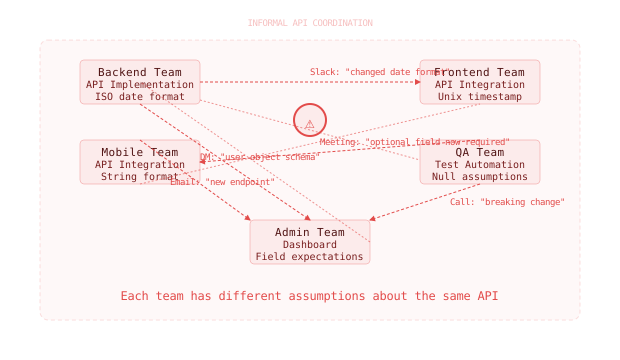
The problems multiply as teams grow:
First, communication latency. When a backend engineer wants to add a field, they need to check with three frontend teams, two mobile teams, and the QA automation team. Each conversation happens at different times with different people. By the time everyone is “aligned,” the original requirement has changed.
Second, interpretation differences. When you say “the user object,” do you mean the full user profile with preferences and settings, or the minimal user identity for authentication? Different teams hear different things from the same conversation.
Third, change tracking. There’s no single place to see what changed, when it changed, and who needs to be notified. Breaking changes get deployed because someone forgot to notify the mobile team, or because the notification got lost in Slack.
Small scale: 2 teams, 1 API -> informal communication works
Large scale: 6 teams, 12 APIs -> communication becomes bottleneck
At large scale, API evolution stops because the coordination cost exceeds the value of the change. Teams start building workarounds instead of fixing the root issues.
Informal communication creates false confidence - everyone thinks they’re aligned because they talked about it, but without a written specification, each person remembers different details.
The Better Solution
Here’s what actually fixes this: API-first development with explicit contracts and automated validation. Think of it like architectural blueprints - everyone builds from the same plan, and deviations are caught before construction starts.
OpenAPI Specification as Source of Truth
Start with the API specification, not the implementation. The specification defines exactly what the API does, what data it accepts and returns, and how errors are handled.
# users-api.openapi.yaml
openapi: 3.0.3
info:
  title: Users API
  version: 1.2.0
  description: User management for customer platform

paths:
  /users/{userId}:
    get:
      summary: Get user profile
      parameters:
        - name: userId
          in: path
          required: true
          schema:
            type: string
            format: uuid
            example: "123e4567-e89b-12d3-a456-426614174000"
      responses:
        '200':
          description: User profile
          content:
            application/json:
              schema:
                $ref: '#/components/schemas/User'
        '404':
          description: User not found
          content:
            application/json:
              schema:
                $ref: '#/components/schemas/Error'

components:
  schemas:
    User:
      type: object
      required:
        - id
        - email
        - createdAt
      properties:
        id:
          type: string
          format: uuid
          description: Unique user identifier
        email:
          type: string
          format: email
          description: User's email address
        name:
          type: string
          nullable: true
          description: User's display name (optional)
        verified:
          type: boolean
          description: Email verification status
          default: false
        createdAt:
          type: string
          format: date-time
          description: Account creation timestamp (ISO 8601)
        preferences:
          $ref: '#/components/schemas/UserPreferences'
          nullable: true

    UserPreferences:
      type: object
      properties:
        theme:
          type: string
          enum: [light, dark, auto]
          default: auto
        notifications:
          type: boolean
          default: true

    Error:
      type: object
      required:
        - code
        - message
      properties:
        code:
          type: string
          description: Error code for programmatic handling
        message:
          type: string
          description: Human-readable error description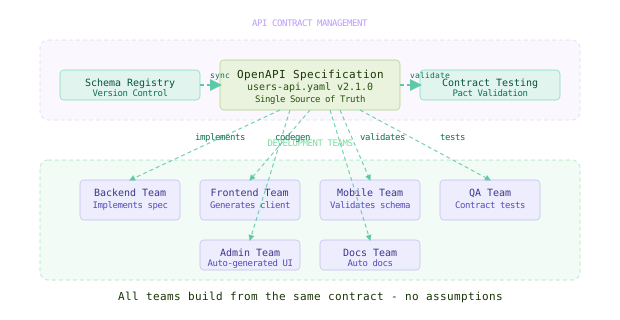
This specification is unambiguous. Every field has a defined type, required fields are explicit, and optional fields are clearly marked as nullable. Both producer and consumer teams build against this contract.
Stripe’s API success comes from their obsessive focus on contract stability - they version every change, maintain backward compatibility for years, and make breaking changes so rarely that developers trust building long-term integrations.
Consumer-Driven Contract Testing
Contracts should be driven by actual consumer needs, not producer assumptions. Consumer teams define what they need, producer teams implement to satisfy those requirements.
// Consumer contract test (using Pact)
const { PactV3, MatchersV3 } = require('@pact-foundation/pact');

describe('Users API Contract', () => {
  const provider = new PactV3({
    consumer: 'WebApp',
    provider: 'UsersAPI'
  });

  describe('GET /users/:id', () => {
    it('returns user profile for valid ID', async () => {
      // Consumer defines what they need
      provider
        .given('user 123e4567-e89b-12d3-a456-426614174000 exists')
        .uponReceiving('a request for user profile')
        .withRequest({
          method: 'GET',
          path: '/users/123e4567-e89b-12d3-a456-426614174000',
          headers: { 'Accept': 'application/json' }
        })
        .willRespondWith({
          status: 200,
          headers: { 'Content-Type': 'application/json' },
          body: {
            id: MatchersV3.uuid('123e4567-e89b-12d3-a456-426614174000'),
            email: MatchersV3.email('user@example.com'),
            name: MatchersV3.string('John Doe'),
            verified: MatchersV3.boolean(true),
            createdAt: MatchersV3.iso8601DateTime('2024-01-15T10:30:00Z'),
            preferences: {
              theme: MatchersV3.string('dark'),
              notifications: MatchersV3.boolean(true)
            }
          }
        });

      await provider.executeTest(async (mockService) => {
        const client = new UsersAPIClient(mockService.url);
        const user = await client.getUser('123e4567-e89b-12d3-a456-426614174000');

        expect(user.id).toBe('123e4567-e89b-12d3-a456-426614174000');
        expect(user.email).toBe('user@example.com');
        expect(typeof user.verified).toBe('boolean');
        expect(new Date(user.createdAt)).toBeInstanceOf(Date);
      });
    });
  });
});
Schema Registry and Validation
Use a central schema registry to version and validate API contracts. All changes go through the registry, which enforces compatibility rules and prevents breaking changes.
# Schema registry integration
import json
from schema_registry.client import SchemaRegistryClient
from schema_registry.serializers import AvroSerializer

class UserAPIClient:
    def __init__(self, schema_registry_url, api_base_url):
        self.registry = SchemaRegistryClient(schema_registry_url)
        self.api_base_url = api_base_url

        # Load current schema from registry
        self.user_schema = self.registry.get_latest_schema('users-api-user-v1')
        self.serializer = AvroSerializer(self.user_schema)

    def get_user(self, user_id: str) -> dict:
        response = requests.get(f'{self.api_base_url}/users/{user_id}')
        response.raise_for_status()

        user_data = response.json()

        # Validate response against schema
        try:
            validated_user = self.serializer.decode(
                self.serializer.encode(user_data)
            )
            return validated_user
        except ValidationError as e:
            raise APIContractViolation(
                f'API response does not match contract: {e}'
            )

    def update_user(self, user_id: str, updates: dict) -> dict:
        # Validate request against schema before sending
        try:
            self.serializer.encode(updates)
        except ValidationError as e:
            raise APIContractViolation(
                f'Request does not match contract: {e}'
            )

        response = requests.put(
            f'{self.api_base_url}/users/{user_id}',
            json=updates
        )
        response.raise_for_status()
return response.json()The most important mechanism is making contract violations fail fast and loud - when integration breaks, both teams should know immediately what contract assumption was violated.
The Full Architecture
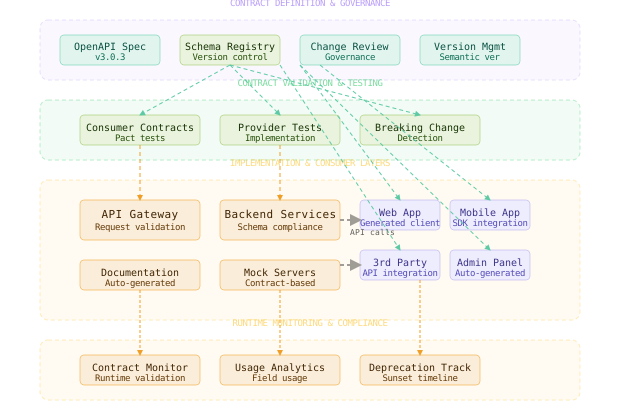
The complete architecture centers the API contract as the coordination point between teams. The schema registry maintains contract versions and enforces compatibility rules. Consumer teams write contract tests defining their requirements. Producer teams implement to satisfy these contracts and validate responses against the schema.
When a team wants to change an API, the change goes through a defined process: propose the change in the OpenAPI spec, validate that it doesn’t break existing consumer contracts, get approval from affected teams, and deploy with proper versioning. Breaking changes are avoided when possible and carefully planned when necessary.
The contract becomes living documentation that stays accurate because it’s enforced by automated tests. New team members can understand the API by reading the specification. Integration problems are caught in CI/CD before they reach production.
The key design decision is making the contract the authoritative source of truth, not the implementation - code should conform to contracts, not the other way around.
Component Deep Dives
OpenAPI Specification Management
The API specification needs to be treated as code: versioned, reviewed, and tested like any other software artifact.
# API specification with proper versioning
openapi: 3.0.3
info:
  title: Users API
  version: 2.1.0  # Semantic versioning
  description: |
    User management API for customer platform

    ## Versioning Policy
    - Major version: breaking changes (rare)
    - Minor version: backward-compatible additions
    - Patch version: bug fixes and clarifications

    ## Deprecation Policy
    - Deprecated features marked 30 days before removal
    - Sunset date included in deprecation notice
    - Alternative approaches documented
  contact:
    name: Platform Team
    email: platform-team@company.com
  license:
    name: MIT

# Change tracking in specification
paths:
  /users/{userId}:
    get:
      summary: Get user profile
      deprecated: false
      x-changelog:
        - version: "2.1.0"
          date: "2024-01-15"
          description: "Added preferences object"
        - version: "2.0.0"
          date: "2024-01-01"
          description: "Changed date format to ISO 8601"
        - version: "1.0.0"
          date: "2023-12-01"
          description: "Initial API release"
Contract Testing Pipeline
Integrate contract testing into the CI/CD pipeline to catch breaking changes before they’re deployed.
# .github/workflows/contract-tests.yml
name: Contract Tests
on:
  pull_request:
    paths: ['api-spec/**', 'src/**']

jobs:
  contract-validation:
    runs-on: ubuntu-latest
    steps:
    - uses: actions/checkout@v3

    - name: Validate OpenAPI Spec
      run: |
        npx swagger-codegen-cli validate -i api-spec/users-api.yaml

    - name: Generate Contract Tests
      run: |
        # Generate client code from spec
        npx @openapitools/openapi-generator-cli generate \
          -i api-spec/users-api.yaml \
          -g typescript-fetch \
          -o generated/client

    - name: Run Consumer Contract Tests
      run: |
        # Consumer teams run their contract tests
        npm run test:contracts:web-app
        npm run test:contracts:mobile-app
        npm run test:contracts:admin-dashboard

    - name: Validate Provider Contract
      run: |
        # Provider validates they satisfy all consumer contracts
        npm run test:provider-contracts

    - name: Check Breaking Changes
      run: |
        # Compare with previous API version
        npx openapi-diff \
          api-spec/previous/users-api.yaml \
          api-spec/users-api.yaml \
          --fail-on-breaking
API Governance and Change Management
Establish clear processes for API evolution that balance agility with stability.
# API change approval workflow
from typing import List, Dict
from enum import Enum
from dataclasses import dataclass
from datetime import datetime, timedelta

class ChangeType(Enum):
    BREAKING = "breaking"
    ADDITIVE = "additive"
    DEPRECATION = "deprecation"
    BUG_FIX = "bug_fix"

@dataclass
class APIChange:
    change_type: ChangeType
    description: str
    affected_endpoints: List[str]
    proposed_date: datetime
    sunset_date: datetime = None
    consumer_impact: Dict[str, str] = None

class APIGovernancePolicy:
    def __init__(self):
        self.breaking_change_notice_days = 30
        self.deprecation_period_days = 90
        self.required_approvers = {
            ChangeType.BREAKING: ["platform-lead", "consumer-teams"],
            ChangeType.ADDITIVE: ["platform-lead"],
            ChangeType.DEPRECATION: ["platform-lead", "consumer-teams"],
            ChangeType.BUG_FIX: ["platform-lead"]
        }

    def validate_change(self, change: APIChange) -> List[str]:
        errors = []

        if change.change_type == ChangeType.BREAKING:
            if not change.sunset_date:
                errors.append("Breaking changes must specify sunset date")

            notice_period = (change.proposed_date - datetime.now()).days
            if notice_period < self.breaking_change_notice_days:
                errors.append(
                    f"Breaking changes require {self.breaking_change_notice_days} days notice"
                )

        if change.change_type == ChangeType.DEPRECATION:
            if not change.sunset_date:
                errors.append("Deprecations must specify sunset date")

            deprecation_period = (change.sunset_date - change.proposed_date).days
            if deprecation_period < self.deprecation_period_days:
                errors.append(
                    f"Deprecation period must be at least {self.deprecation_period_days} days"
                )

        return errors

    def get_required_approvals(self, change: APIChange) -> List[str]:
        return self.required_approvers.get(change.change_type, [])

# Usage in change request process
def submit_api_change(change: APIChange):
    policy = APIGovernancePolicy()

    validation_errors = policy.validate_change(change)
    if validation_errors:
        raise ValueError(f"Invalid change request: {validation_errors}")

    required_approvers = policy.get_required_approvals(change)

    # Send notifications to required approvers
    for approver in required_approvers:
        send_approval_request(approver, change)

    # Create tracking issue
    create_change_tracking_issue(change, required_approvers)
The governance process ensures that all stakeholders understand the impact of API changes and have time to adapt their implementations.
Comparison Table
| Approach | Setup Complexity | Change Velocity | Integration Reliability | Documentation Quality | Maintenance Overhead | Best Use Case |
|---|---|---|---|---|---|---|
| Informal communication | Very Low | High | Very Low | Poor | Very High | Prototype/MVP only |
| Shared documentation | Low | Medium | Low | Medium | High | Small teams, simple APIs |
| OpenAPI specification | Medium | Medium | High | High | Medium | Most production APIs |
| Consumer-driven contracts | High | Low | Very High | Very High | Medium | Critical integrations |
| Full schema registry | Very High | Low | Very High | Very High | Low | Enterprise multi-team |
| GraphQL federation | Very High | High | High | High | High | Complex data requirements |
For most production APIs, OpenAPI specifications provide the best balance of reliability and development velocity. Consumer-driven contracts add value for critical integrations where stability is more important than change speed.
Key Takeaways
- Implicit contracts are created by consumer assumptions regardless of whether you write explicit contracts - explicit contracts let you control those assumptions
- API-first development means writing the specification before writing the implementation - the contract drives development, not the other way around
- Consumer-driven contracts ensure APIs actually serve consumer needs instead of producer convenience
- Contract testing validates that implementations match specifications and that changes don’t break existing consumers
- Schema registries provide central governance and compatibility checking for API evolution
- Breaking changes should be rare, well-planned, and given adequate notice to all consumer teams
- Semantic versioning communicates the impact of changes clearly - major versions for breaking changes, minor for additions, patch for fixes
- Change governance balances agility with stability by establishing clear processes for different types of API evolution
The hardest lesson about API contracts is that they feel like overhead until you need them. A five-minute conversation feels faster than writing a specification, but that conversation becomes expensive technical debt when it needs to be repeated across six teams and maintained for two years.
Frequently Asked Questions
Q: How do you handle API versioning when multiple consumer teams move at different speeds? A: Maintain multiple API versions simultaneously with clear deprecation timelines. Use semantic versioning to communicate change impact. Provide automated migration tools when possible. Set organization-wide policies for minimum supported version lifetimes (typically 6-12 months for breaking changes).
Q: What’s the difference between OpenAPI specs and consumer-driven contracts? A: OpenAPI specs define what the producer offers. Consumer-driven contracts define what consumers actually need and use. OpenAPI is producer-centric documentation. Consumer contracts are automated tests that fail when producer changes break consumer assumptions. Use both: OpenAPI for documentation, Pact-style tests for validation.
Q: How do you enforce contract compliance when teams have different priorities? A: Make contract violations break the build in CI/CD pipelines. Use automated tools to detect breaking changes and require explicit approval for them. Establish organization-wide API governance policies with defined approval processes. Make contract testing part of the definition-of-done for all API changes.
Q: Should internal microservice APIs use the same contract rigor as public APIs? A: Yes, often more rigor. Public APIs have motivated external consumers who will complain about breaking changes. Internal APIs have busy internal teams who might not notice breaking changes until production fails. Internal contract failures are often harder to debug because there’s less visibility into integration assumptions.
Q: How do you handle contract evolution for high-frequency trading or real-time systems? A: Use schema evolution strategies that support forward and backward compatibility (Avro, Protocol Buffers). Implement feature flags for gradual contract changes. Use canary deployments to validate contract changes under real load. Consider event-driven architectures where consumers can adapt to schema changes more flexibly than request-response APIs.
Q: What happens when consumer contract tests conflict with each other? A: This reveals that different consumers need different APIs. Options: 1) Design the API to satisfy all consumer needs (more complex API), 2) Create consumer-specific API endpoints (more APIs to maintain), 3) Use API gateways to transform a single API for different consumer needs, 4) Have consumers adapt to a common contract (more consumer complexity). Choose based on your organization’s priorities.
Interview Questions
Q: Design an API versioning strategy for a payment platform that serves web, mobile, and third-party integrations. Expected depth: Discuss semantic versioning, backward compatibility guarantees, deprecation timelines, URL versioning vs header versioning vs content negotiation. Address different consumer update cycles, migration support, and monitoring for deprecated API usage. Consider regulatory compliance and third-party integration constraints.
Q: How would you implement consumer-driven contract testing across 20 microservices with 50+ integrations? Expected depth: Plan contract testing infrastructure, CI/CD pipeline integration, contract change approval workflows, and tooling (Pact, Spring Cloud Contract). Address contract storage, version management, and testing execution at scale. Discuss organizational processes for contract changes and breaking change management.
Q: Your API breaking change was deployed accidentally and broke 5 consumer services. How do you recover? Expected depth: Immediate rollback procedures, consumer service recovery, incident communication, post-incident process improvements. Discuss automated rollback triggers, backward compatibility testing, blue-green deployments for API changes, and contract testing gaps that allowed the incident.
Q: Design a schema registry system that supports both REST APIs and event streaming with Kafka. Expected depth: Schema storage and versioning, compatibility checking (forward, backward, full), integration with API gateways and Kafka producers/consumers. Address schema evolution policies, tooling for developers, and operational concerns like schema registry high availability and disaster recovery.
Q: How would you migrate a legacy API with 100+ consumers from XML to JSON without breaking integrations? Expected depth: Plan dual-format support, content negotiation, gradual migration strategy, consumer communication. Discuss adapter patterns, legacy wrapper services, monitoring consumer format usage, and migration completion criteria. Address performance implications of supporting both formats.
Want to see how these patterns hold up when traffic spikes 50x at 3 AM? That's exactly what this Premium deep-dive covers.