Build a Token Budget Management System for LLM APIs
performance scalability caching
AI System Design Deep Dive
Token Budget Management
Billing the tenant after the GPU finishes is too late. The money is already spent at admission.
Think of every LLM request as a taxi ride with no meter. A tenant sends a prompt, a GPU spins up, and the cost accumulates token by token until generation finishes. By the time you know the bill, the money is gone. For a single request that is fine. For a multi-tenant platform handling 10,000 requests per second with tenants running 128,000-token context windows at $0.06 per million output tokens, the absence of admission control converts a software bug into a $50,000 monthly overrun before the on-call engineer gets paged.
The naive approach is to track usage after the fact and cut tenants off when they exceed their quota. That approach has a fatal flaw: the GPU does not care about your accounting job. Output tokens generated by over-budget requests are real silicon cycles, real cooling watts, and real dollars billed by your cloud provider. Post-hoc accounting is a refund process dressed up as a quota system.
Correct token budget management works like a prepaid phone plan, not a credit card. Before a single GPU cycle fires, a pre-flight check verifies that the tenant has enough tokens remaining, reserves the estimated cost atomically, and either admits or rejects the request in under 2 milliseconds. Over-budget tenants hit a 429 before inference starts. GPU time goes to tenants who can pay for it.
This post designs that system end to end: the enforcement layer that runs before every request, the token counter that knows exactly how much each model will consume, the quota store that handles 10,000 concurrent atomic decrement operations in Redis, and the billing aggregator that makes the numbers match the cloud invoice.
Requirements and Constraints
Functional Requirements
- Admission control: Reject requests from tenants who have exhausted their token budget before inference starts, returning a structured 429 with retry timing.
- Real-time token counting: Count input tokens accurately per model using the correct tokenizer (cl100k_base for GPT-4-class models, a model-specific tokenizer for open-weight models) before admission.
- Output token tracking: Accumulate output tokens during streaming generation and attribute them to the originating tenant in real time.
- Budget windows: Enforce budgets at per-minute, per-day, and per-month granularities simultaneously, with configurable soft and hard limits per window.
- Cost attribution: Track input and output tokens separately because they carry different prices per model tier, and attribute costs to specific models and API keys.
- Alerts and suspension: Fire webhook alerts at configurable soft-limit thresholds (80 percent, 95 percent), suspend tenants automatically at 100 percent of the hard limit, and allow a configurable grace buffer for in-flight requests.
Non-Functional Requirements
| Metric | Target | Notes |
|---|---|---|
| Admission control latency | under 2ms p99 | Added overhead per request on the critical path |
| Throughput | 10,000 req/s | Across all tenants simultaneously |
| Token count accuracy | within 2% of actual billing | tiktoken produces exact counts for OpenAI models |
| Counter drift | under 0.5% across budget windows | Redis atomic ops prevent split-brain; audit job detects drift |
| Alert delivery latency | under 5 seconds | Webhook with async queue, not blocking the request path |
| Quota enforcement latency | under 2ms p99 | Redis Lua script evaluated atomically per request |
Constraints
- No GPU waste on rejected requests. The enforcement check must complete before any model is loaded or KV cache allocated.
- Atomic decrement or reject. If two pods check a budget simultaneously and both see “budget available,” only one must win. This requires a compare-and-decrement atomic operation, not a read-then-write.
- Streaming complicates output accounting. We do not know how many output tokens a streaming request will produce until the stream ends. We must pessimistically reserve
max_tokensat admission and refund the delta on completion. - Input and output tokens price differently. A typical 70B-class model charges $0.03 per million input tokens and $0.06 per million output tokens. A budget system that treats them as the same unit will systematically undercount cost.
- Tokenizer per model. GPT-4o uses cl100k_base. Claude uses a different tokenizer. Llama 3 uses tiktoken with a SentencePiece vocabulary. Token counts are not portable across model families.
High-Level Architecture
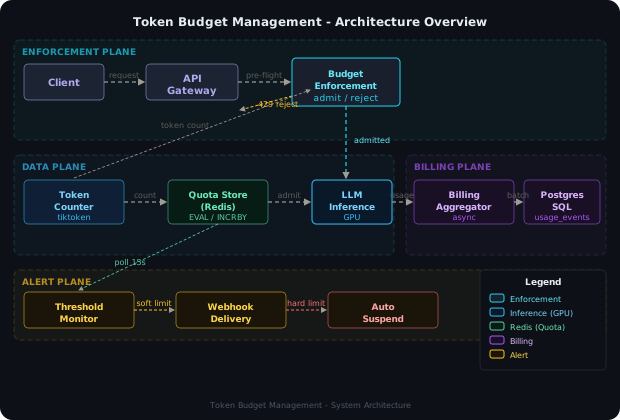
The system breaks into four planes that operate at different latency tiers.
Enforcement Plane runs synchronously on every request path. The API Gateway calls the Budget Enforcement Layer, which counts input tokens, performs an atomic check-and-decrement in Redis, and either issues an admit decision or returns a 429. The entire round trip must complete in under 2ms.
Data Plane handles the inference itself and the real-time tracking of output tokens during streaming. The Streaming Token Counter sits between the LLM inference engine and the gateway, counting tokens as they arrive in the SSE stream and accumulating them in Redis.
Billing Plane operates asynchronously. The Billing Aggregator reads usage events from a queue, normalizes them to cost, and flushes to PostgreSQL in batches. It reconciles Redis counters against actual model billing logs to detect drift.
Alert Plane monitors thresholds and fires webhooks. It reads budget utilization from Redis on a configurable interval (typically 15 seconds) and delivers soft-limit warnings before tenants hit the hard cutoff.
The end-to-end flow for an admitted request:
- Client sends request to API Gateway.
- Gateway calls Budget Enforcement Layer with tenant ID, model, input text, and max_tokens.
- Enforcement Layer tokenizes the input, adds max_tokens for a pessimistic estimate, and calls
EVALon the Redis Lua script to atomically check and decrement. - If admitted, the request proceeds to inference. If rejected, a 429 is returned immediately.
- During generation, the Streaming Token Counter tallies output tokens per SSE chunk and writes them to a Redis string with
INCRBY. - On stream end, the Enforcement Layer refunds
max_tokens - actual_output_tokensback to the per-minute bucket. - A usage event is published to the message queue for the Billing Aggregator.
- The Billing Aggregator batches events and writes to PostgreSQL every 5 seconds.
The admission check and the Redis decrement must be a single atomic operation. If you read the budget, decide to admit, then decrement, two pods racing on the same tenant will both read “budget available” and both admit. The Lua script runs as a single unit inside Redis, so the read-check-decrement executes without interleaving from any other operation.
The Budget Enforcement Layer
The Enforcement Layer is a FastAPI service that runs synchronously on the request path. Its job is to accept or reject requests in under 2ms based on current budget state. It must handle 10,000 requests per second, which means each instance handles approximately 1,000 req/s on a 10-pod deployment.
Pre-flight Admission Control
from fastapi import FastAPI, HTTPException, Request
from fastapi.responses import JSONResponse
import redis.asyncio as redis
import tiktoken
import time
app = FastAPI()
redis_client = redis.Redis(host="redis-cluster", port=6379, decode_responses=True)
# Pre-load tokenizers at startup, not per-request
TOKENIZERS = {
"gpt-4o": tiktoken.get_encoding("cl100k_base"),
"gpt-4o-mini": tiktoken.get_encoding("cl100k_base"),
"gpt-4-turbo": tiktoken.get_encoding("cl100k_base"),
}
def count_tokens(model: str, text: str) -> int:
enc = TOKENIZERS.get(model)
if enc is None:
# Fallback: approximate 4 chars per token for unknown models
return max(1, len(text) // 4)
return len(enc.encode(text))
@app.post("/v1/admit")
async def admit_request(request: Request):
body = await request.json()
tenant_id: str = body["tenant_id"]
model: str = body["model"]
prompt: str = body["prompt"]
max_tokens: int = body.get("max_tokens", 1024)
input_tokens = count_tokens(model, prompt)
# Pessimistic reservation: full input + worst-case output
reserved_tokens = input_tokens + max_tokens
admitted, reason = await atomic_check_and_decrement(
tenant_id=tenant_id,
model=model,
input_tokens=input_tokens,
reserved_tokens=reserved_tokens,
)
if not admitted:
raise HTTPException(
status_code=429,
detail={
"error": "token_budget_exceeded",
"reason": reason,
"tenant_id": tenant_id,
"retry_after_seconds": await seconds_until_window_reset(tenant_id),
},
)
return {
"admitted": True,
"input_tokens": input_tokens,
"reserved_tokens": reserved_tokens,
"admission_id": f"{tenant_id}:{int(time.time() * 1000)}",
}
Redis Lua Script for Atomic Check-and-Decrement
The core of admission control is a Lua script that Redis evaluates as a single atomic transaction. No other command from any client runs between the reads and the decrements.
-- atomic_admit.lua
-- KEYS[1] = per-minute counter key e.g. quota:tenant123:tokens:minute:2026072914
-- KEYS[2] = per-day counter key e.g. quota:tenant123:tokens:day:20260729
-- KEYS[3] = per-month counter key e.g. quota:tenant123:tokens:month:202607
-- KEYS[4] = tenant config hash key e.g. quota:tenant123:config
-- ARGV[1] = reserved_tokens (input + max_output)
-- ARGV[2] = current unix timestamp (for TTL initialization)
-- Returns: {"ok", input_tokens_used} or {"err", reason}
local reserved = tonumber(ARGV[1])
local now = tonumber(ARGV[2])
-- Load tenant config
local minute_limit = tonumber(redis.call('HGET', KEYS[4], 'minute_limit') or 0)
local day_limit = tonumber(redis.call('HGET', KEYS[4], 'day_limit') or 0)
local month_limit = tonumber(redis.call('HGET', KEYS[4], 'month_limit') or 0)
local suspended = redis.call('HGET', KEYS[4], 'suspended')
if suspended == '1' then
return {'err', 'account_suspended'}
end
-- Read current counters (GETEX would be cleaner but KEYS[n] pattern needs GET)
local used_minute = tonumber(redis.call('GET', KEYS[1]) or 0)
local used_day = tonumber(redis.call('GET', KEYS[2]) or 0)
local used_month = tonumber(redis.call('GET', KEYS[3]) or 0)
-- Check all three windows before touching any counter
if minute_limit > 0 and (used_minute + reserved) > minute_limit then
return {'err', 'minute_limit_exceeded'}
end
if day_limit > 0 and (used_day + reserved) > day_limit then
return {'err', 'day_limit_exceeded'}
end
if month_limit > 0 and (used_month + reserved) > month_limit then
return {'err', 'month_limit_exceeded'}
end
-- All checks passed; increment all three windows atomically
local new_minute = redis.call('INCRBY', KEYS[1], reserved)
local new_day = redis.call('INCRBY', KEYS[2], reserved)
local new_month = redis.call('INCRBY', KEYS[3], reserved)
-- Set TTL only if the key was just created (INCRBY on a missing key starts at 0)
-- 90 seconds for minute window, 26 hours for day, 35 days for month
if new_minute == reserved then redis.call('EXPIRE', KEYS[1], 90) end
if new_day == reserved then redis.call('EXPIRE', KEYS[2], 93600) end
if new_month == reserved then redis.call('EXPIRE', KEYS[3], 3024000) end
return {'ok', tostring(new_minute), tostring(new_day), tostring(new_month)}
# Calling the Lua script from Python
LUA_SCRIPT = open("atomic_admit.lua").read()
_admit_script = None
async def get_admit_script():
global _admit_script
if _admit_script is None:
_admit_script = redis_client.register_script(LUA_SCRIPT)
return _admit_script
async def atomic_check_and_decrement(
tenant_id: str,
model: str,
input_tokens: int,
reserved_tokens: int,
) -> tuple[bool, str]:
now = int(time.time())
minute_key = f"quota:{tenant_id}:tokens:minute:{now // 60}"
day_key = f"quota:{tenant_id}:tokens:day:{now // 86400}"
month_key = f"quota:{tenant_id}:tokens:month:{now // 2592000}"
config_key = f"quota:{tenant_id}:config"
script = await get_admit_script()
result = await script(
keys=[minute_key, day_key, month_key, config_key],
args=[str(reserved_tokens), str(now)],
)
status = result[0]
if status == "ok":
return True, ""
return False, result[1]
OpenAI’s rate limiting enforces both requests-per-minute and tokens-per-minute simultaneously, which is exactly this dual-window model. The tokens-per-minute window is what prevents a single request with a 128K context from consuming the entire per-minute quota in one shot. Anthropic’s Claude API applies similar dual-axis limits across requests and tokens per minute.
The Token Counter
Accurate token counting is the load-bearing piece of the whole system. An off-by-10-percent count means a tenant can send 10 percent more compute than they paid for, or get rejected 10 percent sooner than they should. The tokenizer must match the model exactly.
tiktoken Integration and Per-Model Tokenizers
import tiktoken
from functools import lru_cache
# Encoding names by model family
MODEL_ENCODING_MAP = {
# GPT-4 family: cl100k_base
"gpt-4o": "cl100k_base",
"gpt-4o-mini": "cl100k_base",
"gpt-4-turbo": "cl100k_base",
"gpt-4": "cl100k_base",
"gpt-3.5-turbo": "cl100k_base",
# GPT-3 legacy
"text-davinci-003": "p50k_base",
# Codex
"code-davinci-002": "p50k_base",
}
@lru_cache(maxsize=16)
def get_encoding(encoding_name: str) -> tiktoken.Encoding:
"""Cache encodings - loading from disk takes ~40ms the first time."""
return tiktoken.get_encoding(encoding_name)
def count_chat_tokens(model: str, messages: list[dict]) -> int:
"""
Count tokens for a chat completion request.
Includes per-message overhead (4 tokens per message for GPT-4-class models).
Reference: https://platform.openai.com/docs/guides/chat/managing-tokens
"""
encoding_name = MODEL_ENCODING_MAP.get(model, "cl100k_base")
enc = get_encoding(encoding_name)
tokens_per_message = 4 # every message: <|im_start|>{role}\n{content}<|im_end|>\n
tokens_per_name = -1 # if there is a name, the role is omitted
total = 0
for msg in messages:
total += tokens_per_message
for key, value in msg.items():
total += len(enc.encode(str(value)))
if key == "name":
total += tokens_per_name
total += 3 # every reply is primed with <|im_start|>assistant
return total
def count_completion_tokens(model: str, text: str) -> int:
"""Count tokens for a raw completion (non-chat) prompt."""
encoding_name = MODEL_ENCODING_MAP.get(model, "cl100k_base")
enc = get_encoding(encoding_name)
return len(enc.encode(text))
# For open-weight models served via vLLM, use the model's own tokenizer
from transformers import AutoTokenizer
import asyncio
_hf_tokenizers: dict[str, AutoTokenizer] = {}
async def count_tokens_vllm(model_path: str, text: str) -> int:
"""
Count tokens using the HuggingFace tokenizer for open-weight models.
Load once and cache. Llama 3 uses a different BPE vocabulary than cl100k_base.
"""
if model_path not in _hf_tokenizers:
loop = asyncio.get_event_loop()
tokenizer = await loop.run_in_executor(
None, AutoTokenizer.from_pretrained, model_path
)
_hf_tokenizers[model_path] = tokenizer
enc = _hf_tokenizers[model_path]
return len(enc.encode(text, add_special_tokens=False))
tiktoken is synchronous and CPU-bound. At 10,000 req/s with an average prompt of 800 tokens, tokenization consumes roughly 40ms of CPU per core per second. Pre-load encodings at startup and run tokenization in a thread pool executor rather than on the asyncio event loop, or you will stall every coroutine in the process while tiktoken hashes BPE merge tables.
Streaming Token Accumulation During SSE
Output token counting cannot wait for the stream to finish. We need a running count as each chunk arrives, both for the refund calculation and for soft-limit warnings during generation.
import asyncio
import httpx
import redis.asyncio as redis
from dataclasses import dataclass, field
@dataclass
class StreamAccumulator:
tenant_id: str
admission_id: str
model: str
reserved_tokens: int
input_tokens: int
output_tokens: int = 0
chunks: list[str] = field(default_factory=list)
def add_chunk(self, text: str, token_count: int) -> None:
self.output_tokens += token_count
self.chunks.append(text)
@property
def total_tokens(self) -> int:
return self.input_tokens + self.output_tokens
async def stream_and_count(
upstream_url: str,
request_body: dict,
accumulator: StreamAccumulator,
redis_client: redis.Redis,
) -> None:
"""
Proxy the SSE stream from the LLM, count tokens per chunk,
and maintain a live counter in Redis.
"""
encoding_name = MODEL_ENCODING_MAP.get(accumulator.model, "cl100k_base")
enc = get_encoding(encoding_name)
live_key = f"quota:{accumulator.tenant_id}:live:{accumulator.admission_id}"
async with httpx.AsyncClient(timeout=120.0) as client:
async with client.stream("POST", upstream_url, json=request_body) as response:
async for line in response.aiter_lines():
if not line.startswith("data:"):
continue
data = line[5:].strip()
if data == "[DONE]":
break
import json
chunk_data = json.loads(data)
delta = chunk_data.get("choices", [{}])[0].get("delta", {})
content = delta.get("content", "")
if content:
chunk_tokens = len(enc.encode(content))
accumulator.add_chunk(content, chunk_tokens)
# Increment live counter in Redis for soft-limit monitoring
await redis_client.incrby(live_key, chunk_tokens)
yield line + "\n\n"
# Stream ended: refund unused reserved output tokens
actual_output = accumulator.output_tokens
over_reserved = accumulator.reserved_tokens - accumulator.input_tokens - actual_output
if over_reserved > 0:
now = int(asyncio.get_event_loop().time())
minute_key = f"quota:{accumulator.tenant_id}:tokens:minute:{int(now) // 60}"
day_key = f"quota:{accumulator.tenant_id}:tokens:day:{int(now) // 86400}"
month_key = f"quota:{accumulator.tenant_id}:tokens:month:{int(now) // 2592000}"
pipe = redis_client.pipeline()
pipe.decrby(minute_key, over_reserved)
pipe.decrby(day_key, over_reserved)
pipe.decrby(month_key, over_reserved)
pipe.delete(live_key)
await pipe.execute()
The refund on stream completion is not optional. If a tenant requests max_tokens=4096 and the model generates 312 tokens before stopping, you over-charged them 3,784 tokens. At 10,000 req/s with an average over-reservation of 2,000 tokens per request, failing to refund inflates usage numbers by 20 million tokens per second relative to actual consumption, making every quota look exhausted within minutes.
The Quota Store
The Quota Store is the Redis tier that holds budget state for all tenants. Its design determines throughput, correctness, and failure behavior under load.
Redis Data Structures and Key Schema
We use three types of Redis data structures for three different purposes.
String keys with TTL for fixed-window counters. Simple, fast, and self-expiring. The key encodes the window boundary so we never need a separate cleanup job.
quota:{tenant_id}:tokens:minute:{unix_minute} -> integer (tokens used)
quota:{tenant_id}:tokens:day:{unix_day} -> integer (tokens used)
quota:{tenant_id}:tokens:month:{unix_month} -> integer (tokens used)
Hash keys for tenant configuration. One HGETALL retrieves the full quota config in a single round trip.
quota:{tenant_id}:config -> {
minute_limit: "2000000", # 2M tokens/minute
day_limit: "50000000", # 50M tokens/day
month_limit: "1000000000", # 1B tokens/month
soft_pct: "80", # alert at 80%
hard_pct: "100", # hard cutoff at 100%
grace_tokens: "10000", # extra tokens for in-flight at cutoff
suspended: "0", # 1 = suspended
plan: "pro",
model_tier: "all", # "small", "large", "all"
}
Sorted Sets for sliding window implementation. Score is the unix timestamp, member is the usage event ID. We use ZRANGEBYSCORE with the window lower bound to sum only events within the window.
quota:{tenant_id}:sliding:tokens -> sorted set, score=timestamp, member="{event_id}:{token_count}"
Sliding Window vs Fixed Window
Fixed windows are fast and storage-efficient but have a burst edge case: a tenant can consume their full minute quota in the last second of one window, then immediately consume it again in the first second of the next window, effectively consuming 2x the quota in 2 seconds.
import time
import redis.asyncio as redis
async def sliding_window_count(
redis_client: redis.Redis,
tenant_id: str,
window_seconds: int = 60,
) -> int:
"""
Sum tokens used in the last `window_seconds` using a sorted set.
Each member encodes the token count: "{event_id}:{tokens}".
"""
now = time.time()
window_start = now - window_seconds
key = f"quota:{tenant_id}:sliding:tokens"
# Remove expired members, then fetch the remaining range
pipe = redis_client.pipeline()
pipe.zremrangebyscore(key, "-inf", window_start)
pipe.zrangebyscore(key, window_start, "+inf")
_, members = await pipe.execute()
total = 0
for member in members:
parts = member.rsplit(":", 1)
if len(parts) == 2:
total += int(parts[1])
return total
async def sliding_window_add(
redis_client: redis.Redis,
tenant_id: str,
event_id: str,
tokens: int,
ttl_seconds: int = 90,
) -> None:
"""Add a usage event to the sliding window sorted set."""
key = f"quota:{tenant_id}:sliding:tokens"
now = time.time()
await redis_client.zadd(key, {f"{event_id}:{tokens}": now})
await redis_client.expire(key, ttl_seconds)
For the per-minute admission check we use fixed windows in the Lua script because they are one INCRBY per key, not a ZRANGEBYSCORE over potentially thousands of members. Sliding windows serve the alerting path where a 200ms latency is acceptable and burst detection matters more than admission latency.
Redis is the backbone of rate limiting at scale. Stripe, Shopify, and virtually every high-volume API platform use Redis string counters with INCRBY and EXPIRE for token-bucket and fixed-window limits. The Redis documentation’s own rate limiting recipe is nearly identical to the Lua script above. The difference at LLM scale is that the “tokens” being counted are language model tokens, not request counts, so the per-request counter increment ranges from 10 to 128,000 rather than the constant 1 you see in HTTP rate limiters.
TTL-Based Window Management
Fixed-window keys expire automatically, which means there is no cleanup job to run. The TTL must be set only once per window boundary - the Lua script handles this by checking whether the counter value after INCRBY equals the increment amount (meaning the key was just created).
# TTL values per window type
WINDOW_TTLS = {
"minute": 90, # 60s window + 30s grace for in-flight requests
"day": 93600, # 86400s + 7200s grace
"month": 3024000, # 30 days + 5 days grace
}
# Key generation with time-boundary encoding
def make_window_keys(tenant_id: str, now: float) -> dict[str, str]:
ts = int(now)
return {
"minute": f"quota:{tenant_id}:tokens:minute:{ts // 60}",
"day": f"quota:{tenant_id}:tokens:day:{ts // 86400}",
"month": f"quota:{tenant_id}:tokens:month:{ts // 2592000}",
"config": f"quota:{tenant_id}:config",
}
The Billing Aggregator
The Billing Aggregator is intentionally off the critical path. It reads usage events from a Kafka topic, normalizes them to dollar cost, and writes to PostgreSQL in batches. Its job is to make the numbers correct and auditable, not to be fast.
Async Flush to PostgreSQL
import asyncpg
import asyncio
import json
from dataclasses import dataclass
from datetime import datetime, timezone
# Pricing table: (input_price_per_million, output_price_per_million)
MODEL_PRICING = {
"gpt-4o": (5.00, 15.00),
"gpt-4o-mini": (0.15, 0.60),
"gpt-4-turbo": (10.00, 30.00),
"meta-llama-3-70b": (0.59, 0.79),
"meta-llama-3-8b": (0.05, 0.08),
}
@dataclass
class UsageEvent:
tenant_id: str
api_key_id: str
model: str
input_tokens: int
output_tokens: int
admission_id: str
started_at: datetime
completed_at: datetime
@property
def input_cost_usd(self) -> float:
input_price, _ = MODEL_PRICING.get(self.model, (0.03, 0.06))
return (self.input_tokens / 1_000_000) * input_price
@property
def output_cost_usd(self) -> float:
_, output_price = MODEL_PRICING.get(self.model, (0.03, 0.06))
return (self.output_tokens / 1_000_000) * output_price
@property
def total_cost_usd(self) -> float:
return self.input_cost_usd + self.output_cost_usd
class BillingAggregator:
def __init__(self, dsn: str, batch_size: int = 500, flush_interval_s: float = 5.0):
self.dsn = dsn
self.batch_size = batch_size
self.flush_interval_s = flush_interval_s
self._buffer: list[UsageEvent] = []
self._lock = asyncio.Lock()
self._pool: asyncpg.Pool | None = None
async def start(self):
self._pool = await asyncpg.create_pool(self.dsn, min_size=2, max_size=10)
asyncio.create_task(self._flush_loop())
async def record(self, event: UsageEvent) -> None:
async with self._lock:
self._buffer.append(event)
if len(self._buffer) >= self.batch_size:
await self._flush()
async def _flush_loop(self) -> None:
while True:
await asyncio.sleep(self.flush_interval_s)
async with self._lock:
if self._buffer:
await self._flush()
async def _flush(self) -> None:
if not self._buffer or self._pool is None:
return
batch = self._buffer[:]
self._buffer.clear()
rows = [
(
e.tenant_id, e.api_key_id, e.model,
e.input_tokens, e.output_tokens,
e.input_cost_usd, e.output_cost_usd, e.total_cost_usd,
e.admission_id, e.started_at, e.completed_at,
)
for e in batch
]
async with self._pool.acquire() as conn:
await conn.executemany(
"""
INSERT INTO usage_events (
tenant_id, api_key_id, model,
input_tokens, output_tokens,
input_cost_usd, output_cost_usd, total_cost_usd,
admission_id, started_at, completed_at
) VALUES ($1,$2,$3,$4,$5,$6,$7,$8,$9,$10,$11)
ON CONFLICT (admission_id) DO NOTHING
""",
rows,
)
Cost Attribution by Model and Tenant
The aggregator exposes a materialized view that the billing dashboard reads directly, rather than aggregating on every request.
-- Materialized view refreshed every 5 minutes
CREATE MATERIALIZED VIEW tenant_cost_summary AS
SELECT
tenant_id,
model,
date_trunc('hour', started_at) AS hour,
SUM(input_tokens) AS total_input_tokens,
SUM(output_tokens) AS total_output_tokens,
SUM(input_cost_usd) AS total_input_cost_usd,
SUM(output_cost_usd) AS total_output_cost_usd,
SUM(total_cost_usd) AS total_cost_usd,
COUNT(*) AS request_count
FROM usage_events
WHERE started_at >= NOW() - INTERVAL '32 days'
GROUP BY tenant_id, model, date_trunc('hour', started_at)
WITH DATA;
CREATE UNIQUE INDEX ON tenant_cost_summary (tenant_id, model, hour);
-- Refresh on a schedule
SELECT cron.schedule('*/5 * * * *', 'REFRESH MATERIALIZED VIEW CONCURRENTLY tenant_cost_summary');
Input and output tokens are not the same cost. For gpt-4o at $5.00 per million input tokens and $15.00 per million output tokens, a request with 1,000 input tokens and 500 output tokens costs $0.0050 in input and $0.0075 in output, for a total of $0.0125. If your system treats them as equal and uses a single price of $0.01 per million, you would charge $0.0015 for the same request: an 88 percent undercharge. At $50,000 per month in GPU costs, that gap is $44,000 of unattributed spend.
Data Model
SQL DDL
-- Tenant table
CREATE TABLE tenants (
id UUID PRIMARY KEY DEFAULT gen_random_uuid(),
name TEXT NOT NULL,
plan TEXT NOT NULL DEFAULT 'free', -- free, pro, enterprise
suspended BOOLEAN NOT NULL DEFAULT false,
created_at TIMESTAMPTZ NOT NULL DEFAULT now(),
updated_at TIMESTAMPTZ NOT NULL DEFAULT now()
);
-- Quota configuration per tenant
CREATE TABLE tenant_quotas (
id UUID PRIMARY KEY DEFAULT gen_random_uuid(),
tenant_id UUID NOT NULL REFERENCES tenants(id),
minute_limit BIGINT NOT NULL DEFAULT 0, -- 0 = unlimited
day_limit BIGINT NOT NULL DEFAULT 0,
month_limit BIGINT NOT NULL DEFAULT 0,
soft_limit_pct INT NOT NULL DEFAULT 80, -- alert threshold
grace_tokens BIGINT NOT NULL DEFAULT 10000, -- in-flight buffer
model_tier TEXT NOT NULL DEFAULT 'all', -- all, small, large
effective_at TIMESTAMPTZ NOT NULL DEFAULT now(),
UNIQUE (tenant_id)
);
-- Per-request usage events (append-only)
CREATE TABLE usage_events (
id BIGSERIAL PRIMARY KEY,
tenant_id UUID NOT NULL,
api_key_id UUID NOT NULL,
model TEXT NOT NULL,
input_tokens INT NOT NULL,
output_tokens INT NOT NULL,
input_cost_usd NUMERIC(12,8) NOT NULL,
output_cost_usd NUMERIC(12,8) NOT NULL,
total_cost_usd NUMERIC(12,8) NOT NULL,
admission_id TEXT NOT NULL,
started_at TIMESTAMPTZ NOT NULL,
completed_at TIMESTAMPTZ NOT NULL,
CONSTRAINT usage_events_admission_id_uniq UNIQUE (admission_id)
) PARTITION BY RANGE (started_at);
-- Monthly partitions for retention management
CREATE TABLE usage_events_2026_07 PARTITION OF usage_events
FOR VALUES FROM ('2026-07-01') TO ('2026-08-01');
CREATE TABLE usage_events_2026_08 PARTITION OF usage_events
FOR VALUES FROM ('2026-08-01') TO ('2026-09-01');
-- Budget alerts log
CREATE TABLE budget_alerts (
id BIGSERIAL PRIMARY KEY,
tenant_id UUID NOT NULL,
alert_type TEXT NOT NULL, -- soft_limit, hard_limit, suspended
window TEXT NOT NULL, -- minute, day, month
used_tokens BIGINT NOT NULL,
limit_tokens BIGINT NOT NULL,
pct_used NUMERIC(5,2) NOT NULL,
fired_at TIMESTAMPTZ NOT NULL DEFAULT now(),
delivered_at TIMESTAMPTZ
);
-- Indexes for dashboard queries
CREATE INDEX ON usage_events (tenant_id, started_at DESC);
CREATE INDEX ON usage_events (model, started_at DESC);
CREATE INDEX ON budget_alerts (tenant_id, fired_at DESC);
Redis Key Schema
# Fixed window counters (STRING, integer value, auto-expiring)
quota:{tenant_id}:tokens:minute:{unix_ts // 60}
quota:{tenant_id}:tokens:day:{unix_ts // 86400}
quota:{tenant_id}:tokens:month:{unix_ts // 2592000}
# Tenant config (HASH)
quota:{tenant_id}:config
# Live stream counter for in-progress requests (STRING, auto-expiring 300s)
quota:{tenant_id}:live:{admission_id}
# Sliding window for burst detection (SORTED SET, score=timestamp)
quota:{tenant_id}:sliding:tokens
# Suspension flag (STRING, "1" or absent)
quota:{tenant_id}:suspended
Protobuf for Usage Events
syntax = "proto3";
package tokenbudget.v1;
message UsageEvent {
string tenant_id = 1;
string api_key_id = 2;
string model = 3;
int64 input_tokens = 4;
int64 output_tokens = 5;
string admission_id = 6;
int64 started_at_ms = 7; // unix milliseconds
int64 completed_at_ms = 8;
// Set by billing aggregator, not gateway
double input_cost_usd = 9;
double output_cost_usd = 10;
}
message AdmissionResult {
bool admitted = 1;
string rejection_reason = 2; // "minute_limit_exceeded" etc.
int64 retry_after_s = 3;
int64 reserved_tokens = 4;
string admission_id = 5;
}
Key Algorithms and Protocols
Token Bucket Algorithm for Rate Limiting
The token bucket algorithm models a bucket that refills at a constant rate and is depleted by each request. It naturally handles bursts up to the bucket capacity while enforcing a steady-state throughput ceiling.
import time
import redis.asyncio as redis
class TokenBucket:
"""
Token bucket for per-tenant request rate limiting.
Separate from the token-count budget: this limits requests/second, not tokens.
Implemented with Redis so it works across multiple gateway pods.
"""
def __init__(
self,
redis_client: redis.Redis,
capacity: int, # max burst size in requests
refill_rate: float, # requests per second
):
self.r = redis_client
self.capacity = capacity
self.refill_rate = refill_rate
async def acquire(self, tenant_id: str, cost: int = 1) -> tuple[bool, float]:
"""
Try to acquire `cost` tokens from the bucket.
Returns (allowed, retry_after_seconds).
"""
key_tokens = f"ratelimit:{tenant_id}:tokens"
key_ts = f"ratelimit:{tenant_id}:last_ts"
now = time.monotonic()
# Lua: refill bucket based on elapsed time, then check capacity
lua = """
local tokens_key = KEYS[1]
local ts_key = KEYS[2]
local now = tonumber(ARGV[1])
local capacity = tonumber(ARGV[2])
local rate = tonumber(ARGV[3])
local cost = tonumber(ARGV[4])
local last_ts = tonumber(redis.call('GET', ts_key) or now)
local elapsed = math.max(0, now - last_ts)
local stored = tonumber(redis.call('GET', tokens_key) or capacity)
local refilled = math.min(capacity, stored + elapsed * rate)
if refilled < cost then
-- Not enough tokens; compute wait
local deficit = cost - refilled
local wait_s = deficit / rate
return {0, tostring(wait_s)}
end
redis.call('SET', tokens_key, tostring(refilled - cost), 'EX', 120)
redis.call('SET', ts_key, tostring(now), 'EX', 120)
return {1, '0'}
"""
script = self.r.register_script(lua)
result = await script(
keys=[key_tokens, key_ts],
args=[str(now), str(self.capacity), str(self.refill_rate), str(cost)],
)
allowed = result[0] == 1
retry_after = float(result[1])
return allowed, retry_after
Sliding Window Counter for Burst Detection
async def get_sliding_window_usage(
redis_client: redis.Redis,
tenant_id: str,
window_seconds: int,
) -> dict[str, int]:
"""
Compute token usage in a rolling window for the alerting path.
More accurate than fixed windows at window boundaries.
"""
now = time.time()
window_start = now - window_seconds
key = f"quota:{tenant_id}:sliding:tokens"
pipe = redis_client.pipeline(transaction=False)
pipe.zremrangebyscore(key, "-inf", window_start)
pipe.zrangebyscore(key, window_start, "+inf", withscores=False)
results = await pipe.execute()
total_tokens = 0
for member in results[1]:
try:
token_count = int(member.rsplit(":", 1)[1])
total_tokens += token_count
except (IndexError, ValueError):
pass
return {"window_seconds": window_seconds, "total_tokens": total_tokens}
Streaming Token Accumulation Protocol
The protocol for handling output token accounting under streaming has three phases, designed so that a pod crash at any phase does not result in permanent over-billing:
Phase 1 - Admission:
reserved_tokens = input_tokens + max_tokens
Redis: INCRBY all three window keys by reserved_tokens (Lua, atomic)
Kafka: publish AdmissionEvent{tenant_id, reserved_tokens, admission_id}
Phase 2 - Streaming:
For each SSE chunk:
output_tokens += count_tokens(chunk.content)
Redis: INCRBY quota:{tenant_id}:live:{admission_id} by chunk_tokens
Phase 3 - Completion:
refund = reserved_tokens - input_tokens - actual_output_tokens
Redis pipeline:
DECRBY minute_key by refund
DECRBY day_key by refund
DECRBY month_key by refund
DEL live key
Kafka: publish UsageEvent{tenant_id, input_tokens, actual_output_tokens, cost}
Recovery (pod crash between Phase 1 and 3):
Hourly reconciliation job scans for live keys with age > 5 minutes
Looks up AdmissionEvent in Kafka for the admission_id
Computes actual output tokens from the live counter at time of crash
Issues corrective DECRBY for the unrefunded portion
Scaling and Performance
Capacity Math
At 10,000 requests per second with an average prompt of 800 input tokens and a max_tokens reservation of 1,200, each admission check writes approximately 2,000 tokens across three Redis keys. That is 30,000 INCRBY calls per second across all tenants. Redis can handle 100,000 to 300,000 simple operations per second on a single instance, so a single Redis primary handles this load easily, but we want cluster mode for high availability and for shard-level isolation.
Throughput math:
10,000 req/s
x 1 Lua EVAL per request (reads 4 keys, writes 3 keys)
= 10,000 Lua EVALs/s
Each EVAL: ~0.1ms execution on Redis (CPU-bound Lua)
Single Redis thread: ~10,000 ops/s is 100% of one CPU
Redis Cluster with 3 shards: tenants distributed by hash slot
Each shard handles ~3,333 Lua EVALs/s -> ~33% CPU per shard
Gives 3x headroom before shard saturation
Memory per tenant:
3 string keys (minute, day, month) x 64 bytes = 192 bytes
1 hash key (config) x ~300 bytes = 300 bytes
1 sorted set (sliding window) x ~50 members x 80 bytes = 4,000 bytes
Total per active tenant: ~4,500 bytes
10,000 active tenants = 45 MB
100,000 active tenants = 450 MB -> fits in a 1GB Redis node
Redis Cluster Sharding
Tenant IDs must hash to the same slot for all keys belonging to that tenant, or the Lua script cannot access them atomically. We use Redis hash tags to force co-location.
def make_tenant_keys(tenant_id: str) -> dict:
"""
Use hash tags {tenant_id} so all keys for a tenant land on the same Redis slot.
This allows the Lua script to access all keys without CROSSSLOT errors.
"""
tag = f"{{{tenant_id}}}"
return {
"minute": f"quota:{tag}:tokens:minute",
"day": f"quota:{tag}:tokens:day",
"month": f"quota:{tag}:tokens:month",
"config": f"quota:{tag}:config",
"sliding": f"quota:{tag}:sliding:tokens",
}
# Redis Cluster client configuration
import redis.asyncio as redis
async def create_redis_cluster() -> redis.RedisCluster:
return await redis.RedisCluster.from_url(
"redis://redis-cluster:6379",
decode_responses=True,
socket_connect_timeout=0.5,
socket_timeout=0.5,
retry_on_timeout=True,
max_connections_per_node=50,
)
Horizontal Scaling of the Enforcement Layer
The enforcement layer is stateless. Each pod reads from and writes to the shared Redis cluster, so adding pods adds throughput linearly up to the Redis cluster’s capacity.
Enforcement pod sizing:
Target: 1,000 req/s per pod at <2ms p99 latency
Each request: ~0.3ms tiktoken (CPU), ~1.2ms Redis round trip, ~0.1ms overhead
Total: ~1.6ms mean, ~1.9ms p99
10,000 req/s requires: 10 pods
At peak x2 headroom: 20 pods
Pod spec: 2 vCPU, 512MB RAM (tiktoken is the CPU consumer)
Kubernetes HPA target: 60% CPU utilization
Min replicas: 5 (for failure tolerance)
Max replicas: 50 (beyond this, Redis cluster is the bottleneck)
The enforcement pods are stateless but Redis is not. Scaling enforcement pods beyond roughly 50 at 1,000 req/s each would push 50,000 Lua EVALs/s into a 3-shard cluster where each shard handles one-third of the tenants. That puts each shard at 16,667 EVALs/s, which is 1.67ms CPU per EVAL on average and starts to crowd out the pipeline pings used for health checks. Shard count, not pod count, is the capacity ceiling.
Cost and Token Economics
Token budget management is itself a cost center. The Redis cluster, enforcement pods, and billing infrastructure consume real resources. The question is whether the control they provide justifies their operational cost.
| Configuration | Monthly cost at 10K req/s | Uncontrolled overage risk | Notes |
|---|---|---|---|
| No quota enforcement | $0 infra overhead | $50,000+/month exposure | A single runaway agent loop can exhaust a month of GPU budget in hours |
| Post-hoc billing only | ~$200/month (DB only) | $5,000-$20,000 exposure | Catches overruns too late; GPU time already consumed |
| Admission control (this design) | ~$1,400/month | Under $200 (grace buffer only) | Redis cluster + 10 enforcement pods, PostgreSQL write path |
| Admission control + soft limits | ~$1,600/month | Near zero | Adds alert infrastructure and webhook delivery |
The $1,400/month enforcement infrastructure against a $50,000/month exposure is a 35x return on infrastructure. That calculus holds even if overruns are infrequent. One runaway production incident - an agent calling an LLM in a loop, a bug that sets max_tokens to 128,000 on every request, a tenant deliberately probing limits - recoups years of enforcement infrastructure cost.
At $0.06 per million output tokens for a 70B model, a single client looping a 128,000-token request every 10 seconds for one hour generates 128,000 tokens x 360 requests = 46 million tokens = $2.76 in that hour. With 100 concurrent tenants doing the same thing, that is $276/hour or $6,624/day. Admission control that adds 2ms to every request and costs $1,400/month is not a cost center; it is a revenue protection mechanism.
Optimization Levers
The biggest cost lever inside the quota system itself is the refund accuracy on streaming responses. If the average request reserves 1,200 output tokens and uses 400, the over-reservation factor is 3x. This inflates effective quota consumption by 3x, requiring tenants to buy 3x more quota than they actually need, which either drives them to competitors or requires you to over-provision quota limits.
# Optimization: use model-specific output length distributions to tighten reservations
# Instead of reserving max_tokens, reserve the p95 output length for the request type
OUTPUT_LENGTH_PRIORS = {
"classification": 15, # 10-token label + some padding
"summarization": 300, # typical summary
"qa": 150, # typical factual answer
"code_generation": 800, # typical function
"default": 512, # conservative fallback
}
def smart_reservation(max_tokens: int, request_type: str | None) -> int:
"""
Reserve the smaller of max_tokens and the p95 output for this request type.
The refund mechanism handles any overshoot.
"""
prior = OUTPUT_LENGTH_PRIORS.get(request_type or "default", 512)
# Never reserve less than 25% of max_tokens (tail protection)
reservation = max(max_tokens // 4, min(max_tokens, prior * 2))
return reservation
Quality, Evaluation, and Guardrails
Token Count Accuracy
The quota system is only as good as its token counts. We measure three types of accuracy:
Admission accuracy: Does the token count used at admission (before inference) match the actual token count reported by the model after inference? For tiktoken with cl100k_base on gpt-4o models, the count is exact. For open-weight models accessed through vLLM, the HuggingFace tokenizer should produce an exact count, but there can be a 1-3 token discrepancy for inputs with special characters or Unicode that the tokenizer normalizes differently than the model.
Refund accuracy: Does actual_output_tokens reported at the end of streaming match what we counted chunk by chunk? Discrepancies arise when the model reports a different token count in its usage field than what tiktoken counts in the output text (due to special tokens not visible in the text stream).
async def verify_token_count_accuracy(
model: str,
prompt: str,
actual_usage: dict, # from API response: {"prompt_tokens": N, "completion_tokens": M}
) -> dict:
"""
Compare our pre-inference count against the model's reported count.
Log discrepancies above 2% for drift detection.
"""
our_count = count_completion_tokens(model, prompt)
model_count = actual_usage.get("prompt_tokens", 0)
if model_count == 0:
return {"status": "no_model_count"}
delta = abs(our_count - model_count)
pct_drift = (delta / max(1, model_count)) * 100
if pct_drift > 2.0:
# Log for drift analysis; do not block the request
import logging
logging.warning(
"token_count_drift model=%s our=%d model=%d drift=%.2f%%",
model, our_count, model_count, pct_drift,
)
return {
"our_count": our_count,
"model_count": model_count,
"delta": delta,
"pct_drift": pct_drift,
"within_tolerance": pct_drift <= 2.0,
}
tiktoken was open-sourced by OpenAI precisely because accurate token counting matters for billing. Before tiktoken, developers estimated token counts using the “4 characters per token” heuristic, which is systematically wrong for code (too low), URLs (too low), and non-English text (sometimes 5x too low for CJK characters). vLLM’s own serving metrics expose a num_prompt_tokens field per request that you can compare against your pre-count to detect tokenizer drift over model updates.
Drift Detection
Counter drift accumulates when pods crash between admission and completion, when the Redis connection times out mid-refund, or when a bug in the Lua script causes incorrect increments. A weekly reconciliation job compares Redis counters against PostgreSQL aggregates and alerts on discrepancies.
async def reconcile_counters(
redis_client: redis.Redis,
pg_pool: asyncpg.Pool,
tenant_id: str,
window_date: str, # "2026-07-29"
) -> dict:
"""
Compare Redis day counter against PostgreSQL aggregate for drift detection.
Run as a daily background job per tenant.
"""
import datetime
day_start = datetime.datetime.strptime(window_date, "%Y-%m-%d")
unix_day = int(day_start.timestamp()) // 86400
# Redis day counter (may have TTL-expired; 0 if expired)
redis_key = f"quota:{tenant_id}:tokens:day:{unix_day}"
redis_count = int(await redis_client.get(redis_key) or 0)
# PostgreSQL authoritative sum
pg_count = await pg_pool.fetchval(
"""
SELECT COALESCE(SUM(input_tokens + output_tokens), 0)
FROM usage_events
WHERE tenant_id = $1
AND started_at >= $2
AND started_at < $2 + INTERVAL '1 day'
""",
tenant_id, day_start,
)
drift = abs(redis_count - pg_count)
drift_pct = (drift / max(1, pg_count)) * 100
return {
"tenant_id": tenant_id,
"window_date": window_date,
"redis_count": redis_count,
"pg_count": pg_count,
"drift": drift,
"drift_pct": drift_pct,
"within_tolerance": drift_pct <= 0.5,
}
Failure Modes and Recovery
| Failure | Detection | Impact | Recovery |
|---|---|---|---|
| Redis primary failover | Sentinel promotes replica in 1-3s; Lua EVAL returns LOADING during transition | 1-3s where admission checks fail; either all reject (fail closed) or all admit (fail open) | Default to fail-open during Redis unavailability with a circuit breaker; log every admitted request for post-hoc audit |
| Redis OOM - counter keys evicted | LRU eviction removes counter keys; next INCRBY restarts counter from zero | Tenant appears to have zero usage; admits over-budget requests | Set maxmemory-policy allkeys-lru and alert when memory > 80%; monitor eviction rate; use OBJECT FREQ to identify high-churn keys |
| Counter drift from pod crash | Reconciliation job detects Redis vs Postgres delta > 0.5% | Tenant charged less than actual (refund not applied) or more (admission count not decremented) | Reconciliation job issues corrective Redis INCRBY/DECRBY based on Kafka event log; correct delta within 1 hour |
| Streaming truncation at client disconnect | SSE stream ends early; completion handler triggers | If refund not applied, tenant is over-charged by max_tokens - actual_tokens | Client disconnect signal triggers refund path; test with asyncio CancelledError on the stream generator |
| Tokenizer version mismatch | tiktoken version upgrade changes byte-pair merges; counts drift 1-3 tokens on affected inputs | Systematic under-counting admits slightly over-budget requests | Pin tiktoken version in requirements.txt; run golden set comparison before upgrading; monitor drift metric |
| Lua script timeout on large sorted set | Sliding window ZRANGEBYSCORE on a tenant with millions of events | Redis blocks other commands for duration of scan; latency spike cluster-wide | Cap sorted set size with ZREMRANGEBYSCORE on every add; enforce 60-minute max TTL on all sliding window keys |
| Kafka consumer lag on billing path | Consumer group lag metric rises above 50,000 events | Billing aggregator falls behind; PostgreSQL usage data is stale | Scale out billing aggregator consumers; Redis is the source of truth for live quota enforcement; Kafka is only for durable billing history |
Fail-open during Redis unavailability is the right default for a public API, but it must come with a hard rate limiter at the gateway level that does not depend on Redis. A simple in-memory token bucket per pod limits damage during the Redis outage window to the pod capacity. Fail-closed (reject all requests when Redis is down) is only appropriate for internal tools where an availability event is acceptable; for customer-facing APIs it converts a partial degradation into a full outage.
Comparison of Approaches
| Approach | Enforcement Latency | Accuracy | Burst Handling | Complexity | Best Fit |
|---|---|---|---|---|---|
| Token bucket (this design) | under 1ms (in-memory) | Request-level, no per-token precision | Handles bursts up to bucket capacity | Low-medium | Request rate limiting per tenant |
| Fixed window counter | under 2ms (Redis INCRBY) | Per-token, exact | Burst edge at window boundary (2x rate possible) | Low | Token budget enforcement per window period |
| Sliding window counter | 2-5ms (ZRANGEBYSCORE) | Per-token, exact | Smooth, no boundary burst | Medium | Accurate rolling-window alerts and auditing |
| Leaky bucket | under 1ms (in-memory) | Request-level | Smoothes all bursts to constant rate | Low-medium | Strict output rate limiting for streaming |
| Pre-paid credits ledger | 5-15ms (DB transaction) | Per-token, exact | No burst; deduct before inference | High | Marketplace billing with real money |
| Post-hoc billing | 0ms on critical path | Per-token, exact (from model billing) | Unlimited (billed afterward) | Low | Trusted internal tenants only |
For multi-tenant production use, fixed window counters in Redis with Lua atomicity are the correct choice for admission control. They run in under 2ms, are atomic, and self-expire. The sliding window belongs in the alerting path, not the admission path. The token bucket belongs at the request rate layer (requests per second), not the token budget layer (tokens per window).
Anthropic’s Claude API combines both axes: a tokens-per-minute limit enforced per organization and a concurrent-request limit enforced per API key. The tokens-per-minute limit is a fixed-window counter reset at the top of each minute. The concurrent request limit is a counting semaphore. Both live in a Redis-equivalent store. The distinction between “how many tokens total this minute” and “how many requests are happening right now” is important because a single 128K-token request can blow the per-minute token budget without hitting the concurrency limit.
Key Takeaways
- Reject before inference, not after. Post-hoc billing lets GPU cycles run for tenants who cannot pay for them. The only correct point to enforce a token budget is at admission, before any compute starts.
- Atomic check-and-decrement is non-negotiable. Read-then-write on a quota counter has a TOCTOU race that allows concurrent pods to collectively over-admit. Redis Lua scripts run atomically and eliminate this race.
- Pessimistic reservation plus refund is the streaming contract. You cannot know output tokens before generation finishes. Reserve max_tokens at admission and refund the delta on stream completion. Without the refund, quota systems over-report consumption by 2-5x.
- Input and output tokens are different prices. A system that treats them as equal will systematically misattribute cost. Use model-specific pricing tables and track them separately in the data model.
- Tokenizer must match the model. tiktoken with cl100k_base is exact for GPT-4-class models. Open-weight models need their own tokenizer. A 20 percent tokenizer mismatch means 20 percent of every request is unaccounted revenue.
- The enforcement layer must be stateless. Each enforcement pod reads from and writes to Redis. Adding pods adds throughput linearly. State in a pod means lost quota state on pod restart.
- Soft limits are operationally critical. Hard limits that fire with no warning create support escalations at midnight. An 80 percent soft-limit webhook gives tenants time to upgrade their plan or reduce their batch jobs before the hard cutoff hits.
- Reconciliation catches what atomicity misses. Lua atomicity prevents races within Redis. Pod crashes, network partitions, and streaming truncations still cause drift. A daily reconciliation job against PostgreSQL is the backstop.
Frequently Asked Questions
Q: Why use Redis for enforcement instead of a relational database?
A: The admission check happens on every single request, synchronously, before inference. At 10,000 req/s, that means 10,000 quota checks per second. A PostgreSQL UPDATE ... RETURNING with a row-level lock handles roughly 5,000 to 15,000 transactions per second on modern hardware, which gives almost no headroom for anything else. Redis processes 100,000 to 300,000 operations per second per CPU core, and a Lua script combining multiple operations takes roughly 0.1ms of Redis CPU. PostgreSQL is the authoritative store for auditing and billing; Redis is the enforcement store for latency-sensitive admission control.
Q: What happens if a tenant exhausts their minute quota but has day and month budget remaining?
A: The Lua script checks all three windows independently and rejects on the first violation. The 429 response includes retry_after_seconds computed from the time remaining in the failing window. For a minute-limit exhaustion, that is 60 seconds or less. The per-minute limit exists to prevent a single tenant from consuming the entire monthly budget in one minute-long batch job, not to throttle overall usage.
Q: How do we handle multi-turn conversations where the prompt grows with each turn?
A: Each turn is a separate admission request. The full conversation history is the prompt, so input tokens grow linearly with conversation length. A 10-turn conversation with 200 tokens per exchange has 2,000 input tokens by turn 10. Budget systems should expose a per-conversation counter to the client so it can warn users before the conversation hits the tenant’s per-minute limit mid-turn. Truncating conversation history is the application-layer workaround; the enforcement layer just counts what it receives.
Q: How do you prevent a single tenant’s sliding-window sorted set from growing unbounded?
A: Cap the TTL on the sorted set at 2x the window size (90 seconds for a 60-second window, 52 hours for a 24-hour window). On every ZADD, run ZREMRANGEBYSCORE to remove members older than the window. For the minute sliding window, a tenant doing 1,000 req/s with 1 event per request accumulates 60,000 members per minute, which is about 5 MB in Redis. Cap the set size with ZREMRANGEBYRANK to keep the last 10,000 members, which is sufficient for any reasonable burst analysis.
Q: Should the refund operation be in the same Redis pipeline as the completion event, or separate?
A: Same pipeline, wrapped in a MULTI/EXEC block. If the refund and the billing event write are not atomic, a pod crash between them leaves either an over-charged counter (refund not applied) or an unbilled event (refund applied but no billing record). In practice we use a Lua script for the refund DECRBY operations (same atomicity guarantee as the admit script) and publish the billing event to Kafka in a separate step. Kafka’s at-least-once delivery means the billing event may be written twice; the ON CONFLICT (admission_id) DO NOTHING clause in the PostgreSQL insert handles idempotency.
Q: How do you handle model pricing changes without restarting the service?
A: Store pricing in the PostgreSQL model_pricing table and cache it in Redis with a 60-second TTL. The billing aggregator reads from the cache on each batch flush and refreshes it on cache miss. The admission check does not read pricing at all - it only checks token counts against token budgets, not dollar limits. Dollar conversion happens in the billing aggregator, which runs off the critical path. This means a pricing change takes effect within 60 seconds with no deployment required.
Interview Questions
Q: Design a token budget enforcement system that handles 10,000 requests per second per tenant across three time windows (minute, day, month) with under 2ms latency. Walk through the data structures and atomicity guarantees.
Expected depth: Explain why a database transaction is too slow (row locks, round trips). Describe Redis string counters with INCRBY. Identify the TOCTOU race when check and increment are separate operations. Introduce the Lua script as the atomicity mechanism and explain why Redis evaluates Lua single-threaded. Describe the three INCRBY calls with TTL initialization. Discuss hash tags for Redis Cluster slot co-location.
Q: A streaming LLM response is cut short at 200 tokens when the client disconnects at token 50. How does this affect your quota accounting, and what do you do about it?
Expected depth: Explain pessimistic reservation: the admission check reserves max_tokens (say 200) at admission. After the client disconnects, only 50 tokens were generated. Without a refund, the tenant is over-charged by 150 tokens. Describe the stream completion handler that triggers on client disconnect (asyncio CancelledError), computes reserved - input - actual_output, and issues a DECRBY across all three window counters. Discuss the crash recovery case where the pod dies before the refund: reconciliation job reads Kafka for reserved amount, reads live counter for actual output, computes delta.
Q: You are running a Redis Cluster for token quota enforcement. Explain why a Lua script that touches multiple keys can fail with a CROSSSLOT error, and how you prevent it.
Expected depth: Redis Cluster assigns each key to a hash slot based on the key name. A Lua script can only touch keys on the same slot. If quota:tenant1:tokens:minute:X and quota:tenant1:config hash to different slots, the EVAL fails. Hash tags ({tenant1}) force Redis to compute the slot only on the bracketed portion, making all keys with {tenant1} land on the same slot. Discuss the tradeoff: all keys for a tenant are on one shard, so a hot tenant becomes a hot shard. Mitigation: add a random suffix to the tenant hash tag to spread across shards, then aggregate in the billing layer (but this breaks Lua atomicity, so it is only appropriate for monitoring, not admission).
Q: How do you ensure that the token count used for admission matches what the model actually consumed, and what do you do when they differ?
Expected depth: tiktoken is exact for OpenAI models. For open-weight models, the HuggingFace tokenizer should match but can drift by 1-3 tokens on edge cases. The model returns a usage field with prompt_tokens and completion_tokens after every request. Compare our pre-count against prompt_tokens and log any delta above 2 percent. This drift is a monitoring signal, not a blocking condition - the request already finished. The billing aggregator uses the model-reported count from the usage field, not our pre-count, so actual billing is always accurate. The pre-count just needs to be close enough for quota admission purposes.
Q: A tenant’s Redis minute counter was evicted by LRU policy during a traffic spike. The next INCRBY restarts it at zero. How do you detect and respond to this?
Expected depth: An evicted counter restarts at zero, which makes the tenant appear to have zero usage at the start of the current minute. Subsequent INCRBY calls build the counter correctly from that point, but the first few seconds of the minute are unaccounted. Detection: the reconciliation job will see a PostgreSQL aggregate higher than the Redis counter for that window. Response options: (1) set maxmemory-policy noeviction and alert on memory pressure rather than allowing eviction of quota keys; (2) use OBJECT ENCODING and OBJECT FREQ to identify high-churn keys and pin them with OBJECT PERSIST; (3) accept the under-counting and design budgets with a 5-10 percent safety margin. For a paid API, option (1) is correct - never let Redis silently drop quota counters.
Premium Content
Unlock the full article along with everything else in the archive — all in one place.